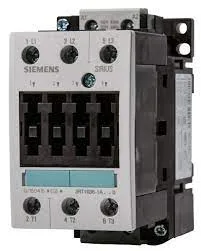
SIRIUS size S2 power contactor for motor switching
Rated at 22 kW in AC-2 duty at 400 V, this contactor handles slip-ring motor reversing or inching applications where the switching frequency is moderate. At 500 V it carries 30 kW, and at 690 V it is rated for 11.4 kW — the voltage derating reflects the higher arc energy at elevated potentials. The coil is wound for 110 V at both 50 Hz and 60 Hz, with an operating range of 0.8 to 1.1 times rated voltage at 50 Hz and 0.85 to 1.1 at 60 Hz.
AC-1 maximum switching rate is 1 000 operations per hour, AC-2 at 400 1/h, AC-3 at 800 1/h, and AC-4 at 300 1/h. These are the thermal limits of the contactor's arc chamber — exceeding them in a given duty class shortens contact life. For a conveyor running AC-3 at 800 cycles per hour, the contactor is within its design envelope; for a welder with AC-4 duty at 300 cycles per hour, it is at the ceiling. Mechanical service life is typical 10 000 000 operations — that is the number of no-load cycles before mechanical wear (spring fatigue, hinge wear) exceeds tolerance. Electrical life will be lower and depends on the switched current and voltage per the manufacturer's derating curves. The auxiliary contact block (integral or add-on, depending on configuration) is rated at 10 A at 24 V, 2 A at 60 V, 1 A at 110 V, 0.3 A at 220 V, 6 A at 230 V, and 3 A at 400 V. These are the make/break capacities for the control circuit — a 24 VDC PLC output sinking 10 A is within range; a 220 VAC pilot light drawing 0.3 A is fine. That gives a total break time around 17 to 35 ms, which matters for coordination with upstream short-circuit protection devices — a typical molded-case breaker with a 50 ms clearing time will see the fault through.
Screw terminals accept solid conductors: 2x (0.5 to 1.5 mm²), 2x (0.75 to 2.5 mm²), and max 2x (0.75 to 4 mm²). Stranded conductors: 2x (0.75 to 25 mm²). Combined solid or stranded: 2x (0.75 to 16 mm²). The 25 mm² upper end on stranded means it can take a 4 AWG cable for the main power circuit without a ferrule, though a ferrule is recommended for stranded terminations in high-vibration environments. Side-by-side mounting is permitted. The dimensions are 55 mm wide, 112 mm high, and 115 mm deep.
Environmental limits and storage
If the panel internal temperature exceeds 60 °C, forced ventilation or a higher-rated contactor is needed.