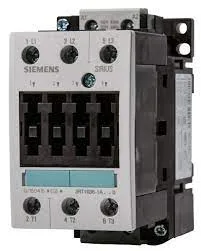
The same contactor is rated 30 kW at 500 V and 11.4 kW at 690 V, so for a 400 V line the 22 kW figure is the one that governs selection. The AC-3 rating (squirrel-cage motors, breaking during running) is the more common motor-switching duty; the AC-2 rating here tells you this contactor is built to handle the higher electrical wear of starting and reversing without derating prematurely. The maximum switching frequency varies by duty: 1,000 cycles/hour in AC-1 (resistive), 800 in AC-3, 400 in AC-2, and 300 in AC-4. For a conveyor running at 20 starts per hour, any of these limits is fine; for a press brake cycling every 10 seconds, the AC-4 limit of 300/hour (one every 12 seconds) is the binding constraint.
The 55 mm width is the S2 frame standard — three of these fit in a 180 mm wide DIN rail section. Height is 112 mm and depth is 164 mm, so plan for at least 170 mm of enclosure depth to clear wiring and arc chutes. Side-by-side mounting is allowed, meaning no derating or air gap is required when contactors are ganged in a row — useful for compact motor control centers. Main circuit terminals are screw-type. Solid wire capacity is 2x (0.5 to 1.5 mm²), 2x (0.75 to 2.5 mm²), max 2x (0.75 to 4 mm²). Stranded wire accepts 2x (0.75 to 25 mm²). That 25 mm² stranded upper limit covers most motor leads up to about 7.5 kW at 400 V with a single cable per phase; for the 22 kW rating you would parallel two cables or use a larger cross-section within the terminal's 2x capacity.
Environmental ratings and approvals
The terminal area is IP00, meaning the wiring compartment must be inside an enclosure to meet touch-safe requirements. Coil ratings cover 50/60 Hz with a tolerance band of 0.8 to 1.1 × rated voltage at 50 Hz and 0.85 to 1.1 at 60 Hz.