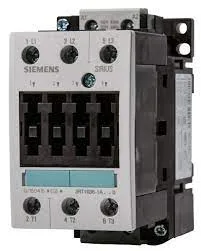
The contactor is rated for 30 kW at 500 V and 11.4 kW at 690 V in AC-3 duty, which covers most three-phase induction motor applications in that power band. For AC-2 duty (slip-ring motors or reversing starts), it carries 22 kW at 400 V. The coil is wound for 220 V at both 50 Hz and 60 Hz, with an operating range of 0.8...1.1 times rated voltage at 50 Hz and 0.85...1.1 at 60 Hz. That means the coil holds in reliably even if the line voltage sags to about 176 V on a 50 Hz supply.
The contactor body measures 55 mm wide by 112 mm high by 164 mm deep. At 55 mm, it occupies a standard three-module width on the DIN rail, so you can plan your enclosure fill factor accordingly. Side-by-side mounting is permitted, which means no mandatory spacing between contactors on the rail. The main power circuit uses screw-type terminals, accepting solid conductors from 2x 0.5...1.5 mm² up to max 2x 0.75...4 mm², and stranded conductors from 2x 0.75...25 mm². That range covers standard motor cables up to about 6 AWG stranded, so no lugging or adapter needed for most installations. Auxiliary contact ratings are given at multiple voltages: 10 A at 24 V, 6 A at 230 V, and 3 A at 400 V. These are the make/break capacities for the control circuit, so verify your PLC output or relay load stays within these limits per the voltage you're switching. That's standard for panel-mounted contactors — the enclosure provides the overall IP rating, and the contactor's own terminal protection is minimal because it's inside a cabinet. That covers most factory-floor panels without special derating.
No last-time-buy urgency or broker-channel scavenging needed for this order code.