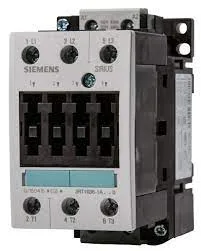
Its AC-3 rating of 30 kW at 500 V means it handles the high inrush of squirrel-cage motors during starting, while the AC-2 rating of 22 kW at 400 V covers slip-ring motor duty. The coil is wound for 400 V at 50 Hz or 400 to 440 V at 60 Hz, with an operating range of 0.8 to 1.1 times rated voltage at 50 Hz and 0.85 to 1.1 at 60 Hz, so it holds in during brownout conditions down to about 320 V.
The main power circuit uses screw-type terminals. Solid wire capacity is 2x (0.5 to 1.5 mm²), 2x (0.75 to 2.5 mm²), max 2x (0.75 to 4 mm²); stranded accepts 2x (0.75 to 25 mm²). That 25 mm² stranded top-end is generous for an S2 frame — it lets you land a 4 AWG cable without pigtailing down. The auxiliary contacts are rated 10 A at 24 V, 6 A at 230 V, and 3 A at 400 V, which covers typical PLC and relay interposing loads. Maximum switching frequency varies by duty: 1000 cycles/hour for AC-1 resistive loads, 800 for AC-3 motor starting, 400 for AC-2 slip-ring, and 300 for AC-4 plugging/inching. If your application cycles a conveyor motor at 600 starts per hour, the AC-3 limit of 800 gives headroom; for a crane hoist with inching duty, the AC-4 limit of 300 is the binding constraint.