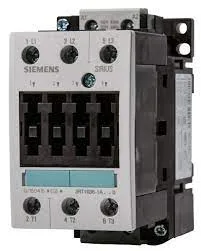
Its 30 kW rating at 500 V in AC-3 duty (cage motors, starting and stopping under load) is the headline number for sizing — that is the current it can break repeatedly during normal motor operation. For less demanding AC-2 applications (slip-ring motors), it carries 22 kW at 400 V.
If your application involves frequent reversing or jogging, this is the figure to check, not the AC-3 number. The auxiliary contact ratings cover a wide control-voltage range: 10 A at 24 V, 6 A at 230 V, 3 A at 400 V, and 0.3 A at 220 V. These are the make-and-break capacities for the coil circuit of the contactor itself or for signaling back to a PLC.
At 40 °C ambient, the minimum permissible conductor cross-section is 16 mm² — a practical detail for panel builders sizing the feed. Front of the contactor carries an IP20 rating (finger-safe), while the terminals themselves are IP00 — meaning the connection points are exposed and require enclosure protection against accidental contact.
RoHS compliance date is noted as May 1, 2012, meaning the design meets the EU Restriction of Hazardous Substances directive effective from that date.