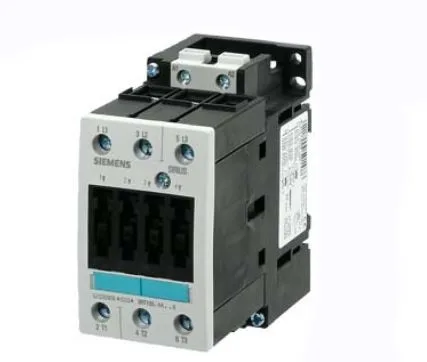
It is rated for AC-3 duty at 22 kW at 400 V, meaning it can handle the inductive load of a standard three-phase induction motor up to that power without excessive contact wear.
The AC-3 rating of 22 kW at 400 V is the headline motor-switching figure — this is the value that decides whether the contactor can start and stop a given motor under full load. For resistive loads (AC-1), the contactor can switch up to 1,000 operations per hour, while AC-3 allows 800 operations per hour, reflecting the higher electrical stress of motor starting. Switching capacity is also specified for DC loads: 10 A at 24 V, 2 A at 60 V, 1 A at 110 V, and 0.3 A at 220 V. These are the maximums for DC-1 duty — useful for breaking DC control circuits or small DC motors, but note the rapid derating as voltage rises. The contactor is rated for a 60 Hz supply with a rated voltage of 277 V (line-to-neutral) and can handle AC-4 duty (plugging/inching) at 41 A at 400 V. AC-4 is the most severe switching category, so this rating gives headroom for applications requiring frequent reversing or jogging.
The 55 mm width and 112 mm height fit standard panel layouts, and side-by-side mounting is allowed with no derating if ambient stays within -25 to +60 °C. The control circuit terminals handle solid 0.5–1.5 mm² and stranded 0.75–2.5 mm².