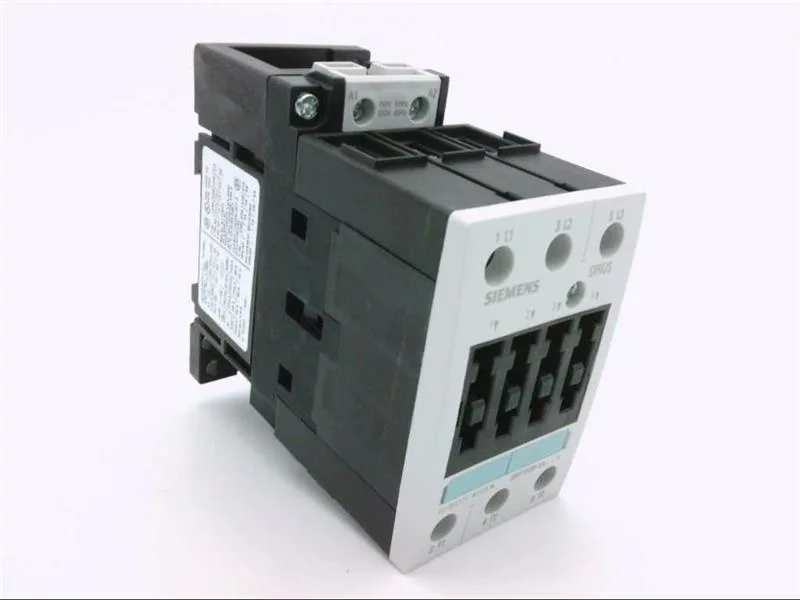
The 55 mm width and 112 mm height leave a compact footprint for a 30 kW AC-3 rated device.
At 400 V AC-3 duty (the standard for squirrel-cage motor switching), this contactor is rated 30 kW — that's the motor power it can handle during starting and running under normal conditions. For AC-2 duty (slip-ring motors, where inrush is lower but switching frequency matters), it carries 22 kW at 400 V. These three duty ratings let you match the contactor to the specific motor control profile, not just a blanket current figure.
Coil and auxiliary ratings
The coil pulls 24 VDC nominal. Auxiliary contacts (built-in or added) are rated for switching at various voltages: 10 A at 24 V, 6 A at 230 V, 3 A at 400 V, and 0.3 A at 220 V DC. The DC switching curve drops sharply with voltage — at 60 V DC it's 2 A, at 110 V DC it's 1 A, at 220 V DC it's 0.3 A. That's typical for DC interruption; arc extinction is harder at higher DC voltages, so the rating reflects the contact gap's capability. For AC auxiliary loads, the 690 V rating is 11.4 kW, which covers most control transformer secondaries.
Main power terminals are screw-type, accepting solid conductors up to 2x (0.5–1.5 mm²), 2x (0.75–2.5 mm²), or max 2x (0.75–4 mm²). The terminal box is IP00 — open-style — so it's intended for enclosure mounting where the cabinet provides the overall IP rating. The front face carries IP20 finger-safe protection, which matters during commissioning or troubleshooting with the panel door open.