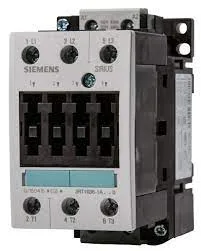
It carries a 24 VDC coil and is rated for 30 kW at 500 V in AC-3 duty — the standard category for squirrel-cage motors during starting and running — so it handles a 30 kW motor at that voltage without derating. The mechanical life is rated at 10,000,000 operations typical, and the operating temperature range of -25 to +60 °C means it can sit in a non-conditioned panel near a crusher or conveyor drive without issues.
The 55 mm width means it takes up one standard module slot, and side-by-side mounting is allowed — no required air gap between contactors, which saves rail space in a dense panel. The IP20 front enclosure protects against finger contact; the terminals themselves are IP00, so the panel door or a terminal cover handles the rest. Wire termination is straightforward: the screw terminals accept solid conductors 2x (0.5 to 1.5 mm²) for control wiring, and stranded main power cable up to 2x (0.75 to 25 mm²).
AC-3 at 400 V is rated at 22 kW — that's the motor-switching rating for a typical 400 V three-phase motor. Switching frequency limits: 1,000 operations per hour at AC-1 (resistive loads), 800/h at AC-3, 400/h at AC-2, and 300/h at AC-4. If your application cycles a motor on and off every few seconds under full load, the AC-3 limit of 800/h means a cycle every 4.5 seconds is the ceiling — stay under that to avoid overheating the coil and contacts.
RoHS compliance date is listed as May 1, 2012, which covers the EU Restriction of Hazardous Substances directive. The substance prohibition date aligns with the standard RoHS2 effective date, so the part is compliant for shipments into regulated markets.