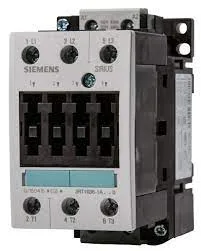
It carries a 22 kW rating at AC-2 duty at 400 V and a 41 A rating at AC-4 at 400 V — the AC-4 figure tells you it can handle reversing or inching duty where the contactor makes and breaks the motor at full locked-rotor current, not just running load.
The front carries an IP20 rating (finger-safe), while the terminal area is IP00 (open). Dimensions: 55 mm wide, 112 mm high, 130 mm deep. That 130 mm depth matters when you're sizing the gland plate or enclosure depth — it's the dimension that sticks out from the rail.
Solid wire acceptance: 2x (0.5... 1.5 mm²), 2x (0.75... 2.5 mm²), max. 2x (0.75... 4 mm²). Stranded: 2x (0.75... 25 mm²) and 2x (0.75... 16 mm²). The 25 mm² stranded capacity on the main circuit is enough for the full rated current without doubling up.
Pollution degree 3 (conductive pollution, typical for industrial enclosures not sealed against dust and moisture). RoHS compliance date 05/01/2012 — the part is RoHS-compliant per the EU directive.
Mechanical endurance typical 10 million operations. Arcing time 10 to 15 ms; dropout time at DC 20 to 25 ms. Maximum operating cycles per hour vary by duty: AC-1 1000 1/h, AC-2 400 1/h, AC-3 800 1/h, AC-4 300 1/h. Coil data: at 24 V rated value 10 A, at 60 V rated value 2 A, at 110 V rated value 1 A, at 220 V rated value 0.3 A, at 230 V rated value 6 A, at 400 V rated value 3 A, at 500 V rated value 30 kW, at 690 V rated value 11.4 kW. Note that the 500 V and 690 V entries are motor power ratings (kW), not coil current — typical for a contactor's main circuit rating at those voltages.