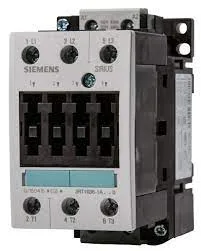
What this contactor does
Rated for AC-3 motor duty at 30 kW on a 500 V line, and 22 kW at 400 V in AC-2 use — that covers most standard 4-pole induction motors up to about 40 HP on a 480 V system. For heavy jogging or plugging duty (AC-4), it's rated 41 A at 400 V.
Substance prohibitance dates to 05/01/2012, indicating RoHS and REACH compliance. No separate UL or IEC listing is in the evidence, but the SIRIUS series typically carries those approvals; verify the specific certification needed for your jurisdiction against the nameplate.
Main circuit terminals accept solid wire from 2x (0.5 to 1.5 mm²) up to 2x (0.75 to 4 mm²) for the control side, and stranded from 2x (0.75 to 25 mm²) for the power side. At 40 °C the minimum permissible conductor is 16 mm² — that's the thermal sizing for full rated current.
Dimensions and switching performance
Physical footprint: 55 mm wide, 112 mm tall, 179 mm deep. That depth matters when you're fitting it into a shallow back panel — measure your enclosure depth before you commit. Coil dropout time at DC is 20 to 25 ms, and arcing time runs 10 to 15 ms. That's fast enough for most safety circuits, but if you're coordinating with a upstream breaker for Type 2 coordination, check the let-through energy curves. Maximum switching frequency: 1000 cycles/hour at AC-1, 800 at AC-3, 400 at AC-2, 300 at AC-4 — so it's fine for frequent starting but not for continuous high-speed jogging.