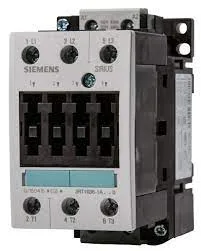
Rated for AC-2 duty at 22 kW at 400 V and 11.4 kW at 690 V, this contactor handles wound-rotor motor switching where moderate inrush and frequent starts are expected. The AC-4 rating of 41 A at 400 V covers plugging and inching applications — the highest thermal stress a contactor sees in motor control. The main circuit uses screw-type terminals, accepting solid conductors up to 2x (0.5 to 1.5 mm²) or 2x (0.75 to 2.5 mm²), and stranded up to 2x (0.75 to 25 mm²). At 40 °C the minimum permissible cross-section is 16 mm², which guides wire sizing for continuous full-load current.
The IP20 rating on the front (IP00 at the terminals) means the contactor body is finger-safe when mounted in an enclosure, but the wiring terminals require the panel door to be closed or a separate finger guard.
Switching frequency limits vary by duty: 1000 cycles/hour for AC-1 (resistive), 800 for AC-3 (squirrel-cage motor start/run), 400 for AC-2, and 300 for AC-4. For a conveyor line running frequent start/stop cycles, the AC-3 rate of 800 cycles/hour is the practical ceiling; exceeding it risks contact welding.
DC switching and control voltage
The contactor coil operates at 230 V rated control voltage, with an undervoltage release threshold of 0.8 times nominal (184 V) and an overload factor of 1.1 (253 V). For DC-13 switching (solenoid loads), the contactor is rated at 10 A at 24 V, 2 A at 60 V, 1 A at 110 V, 0.3 A at 220 V, 6 A at 230 V, and 3 A at 400 V. These are the current limits for inductive DC loads; use them to size the contactor for valve or brake circuits.