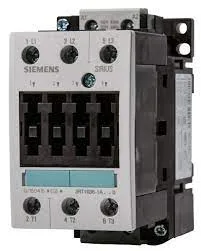
It is rated for 22 kW at 400 V in AC-2 duty (slip-ring motors, reversing starts) and 30 kW at 500 V, making it a fit for medium-horsepower pump, fan, and conveyor drives. The coil accepts 230 V at 50 Hz and 230 V at 60 Hz, with an operating range of 0.8 to 1.1 times rated voltage at 50 Hz and 0.85 to 1.1 at 60 Hz — so it holds in during brownout conditions down to roughly 184 V.
The headline motor ratings are 22 kW at 400 V AC-2 and 11.4 kW at 690 V AC-2. AC-2 is the duty for slip-ring motors and frequent reversing — the contactor sees inrush at every start but not the full locked-rotor current of a direct-on-line squirrel-cage start. If your load is standard squirrel-cage (AC-3), the contactor will handle it, but the AC-3 kW rating is not explicitly listed; the AC-2 figure is the conservative one to spec by. At 500 V the rating climbs to 30 kW, which suggests the contactor is wound for higher-voltage distribution. Switching frequency maxes at 1 000 cycles/hour for AC-1 (resistive), 400 for AC-2, 800 for AC-3, and 300 for AC-4 (plugging/inching). For a conveyor line cycling once per minute, that is well within the AC-3 ceiling of 800/hour. Auxiliary contacts are rated 10 A at 24 V, 6 A at 230 V, and 3 A at 400 V — sufficient for signaling back to a PLC input card or a pilot light. The screw terminals accept 2x (0.25 to 2.5 mm²) solid or 2x (0.75 to 25 mm²) stranded, so panel wiring with standard 1.5 mm² or 2.5 mm² control cable is straightforward.
Dimensions are 55 mm wide, 112 mm high, and 115 mm deep — a standard S2 footprint that fits alongside other SIRIUS S2 components on the same DIN rail. The screw terminals are accessible from the front, and the IP20 front face allows safe probing during commissioning with the panel door open. For a panel near a furnace or in a non-conditioned enclosure in a hot climate, the 60 °C ceiling is the limit to watch — above that, derate the continuous current.