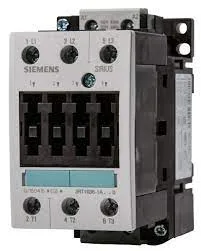
The key motor ratings are 22 kW at 400 V in AC-2 duty (slip-ring motor starting) and 11.4 kW at 690 V in AC-3 duty (squirrel-cage motor starting). The AC-3 figure at 690 V tells you it handles the higher-voltage motor circuits common in heavy industrial lines — pumps, conveyors, compressors — without needing a larger frame. Main circuit connections use screw-type terminals, accepting solid conductors 2x (0.25...2.5 mm²) and stranded conductors 2x (0.75...25 mm²). The terminal range covers control wiring up to motor power cables, so no adapter lugs are needed for typical panel builds.
Dimensions are 55 mm wide, 142 mm high, and 130 mm deep. The 55 mm width is the S2 standard — it occupies three 18 mm module positions on a DIN rail, which matters when you're laying out a dense panel and counting TE per row. Clearance requirements: 10 mm upwards, downwards, forwards, and at the side.
The wide cold-side tolerance (-40 °C) makes this suitable for unheated enclosures in northern climates or cold storage facilities.
Switching performance and auxiliary contacts
The contactor carries zero instantaneous auxiliary contacts (no built-in aux block). If you need feedback for a PLC or status indication, you'll add a separate auxiliary contact block to the front or side — factor that into your BOM line. Mechanical life is typical 10,000,000 operations. Electrical life varies by duty: 1,000,000 operations at AC-1 (resistive), 800,000 at AC-3 (motor), 400,000 at AC-2, and 300,000 at AC-4 (plugging/inching). Coil operating range: rated 110 V, with a pick-up voltage of 0.7 x rated (77 V) and a drop-out of 0.25 x rated (27.5 V). Operating times are 20...25 ms DC closing and 10...15 ms arcing. The 110 V coil suits European control circuits; verify your control transformer taps.