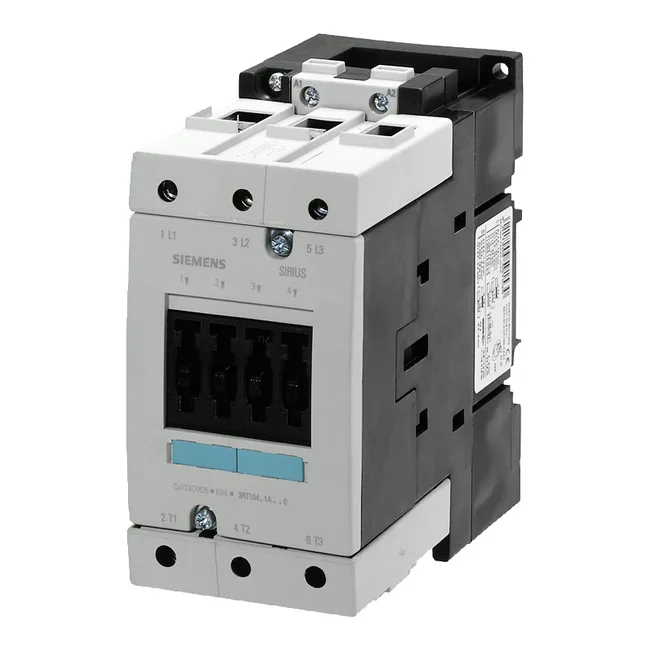
The AC-4 at 400 V rated value of 55 A tells you this contactor is built for the heavy inching and plugging duty that wears out a standard AC-3 contactor fast — AC-4 is the category for reversing, jogging, and braking where the contacts make and break under full locked-rotor current. For motor starting under normal running conditions (AC-3), the contactor is rated at 30 kW at 400 V. At 500 V it delivers 37 kW, and at 690 V it delivers 18.6 kW. These ratings define the load envelope — match your motor's full-load current and duty cycle against them.
The contactor measures 146 mm high, 70 mm wide, and 139 mm deep. Wire termination: solid conductors accept 2x (0.5 to 1.5 mm²), 2x (0.75 to 2.5 mm²), and up to 2x (0.75 to 4 mm²). Stranded conductors take 2x (10 to 50 mm²). Solid or stranded accepts 2x (2.5 to 16 mm²).
Environmental and Operating Limits
The operating range factor at 50 Hz is 0.8 to 1.1 times the rated control supply voltage — the coil will pick up and hold across that band. Switching times: AC closing time 10 to 19 ms, arcing time 10 to 15 ms. Maximum switching frequency varies by duty: AC-1 and AC-3 at 1,000 operations per hour, AC-2 at 400, AC-4 at 300.
The auxiliary contacts are rated for switching: 10 A at 24 V, 2 A at 60 V, 1 A at 110 V, 0.3 A at 220 V, 6 A at 230 V, and 3 A at 400 V. The 230 V and 400 V ratings are the ones that matter for typical control circuit integration — verify your pilot device load against these curves.