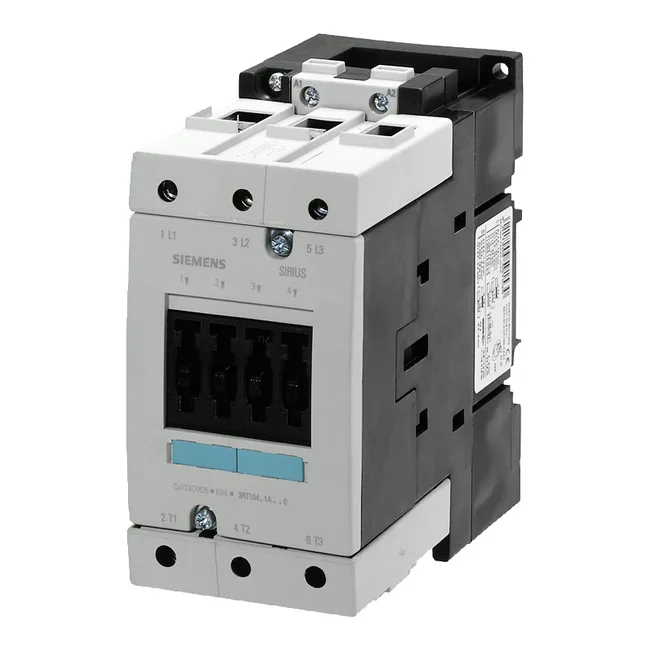
It carries a motor rating of 37 kW at 500 V and 18.6 kW at 690 V, making it a fit for medium-horsepower drives, pumps, and compressors on 400 V to 690 V networks. It mounts via screw or snap-on onto 35 mm or 75 mm standard DIN rail, and its 70 mm width and 146 mm height keep panel layout predictable for a size S3 frame.
The 37 kW at 500 V and 18.6 kW at 690 V are AC-3 duty ratings for standard squirrel-cage motors. AC-3 covers starting and running — the contactor must handle inrush during start and break running current under load. The 690 V rating is particularly relevant for 690 V line-fed drives common in heavy industrial and mining installations. For resistive (AC-1) loads, the contactor can switch up to 1000 operations per hour. For motor (AC-3) loads, the same 1000 1/h applies, but under heavy inching or jogging (AC-4), the rate drops to 300 1/h. That stranded range covers the power feed for a 37 kW motor on 500 V, which typically lands in the 16–35 mm² range depending on cable length and installation method. The contactor is rated for degree of pollution 3, meaning it's suitable for environments with conductive or dry non-conductive pollution — typical for industrial enclosures not hermetically sealed.
The mechanical service life is listed at 10,000,000 operations typical, which for a contactor running at 1000 ops/hour translates to over 11,000 hours of cycling — well beyond the electrical life for most motor-starting duties. That means the contactor will likely be retired due to contact wear, not mechanical failure.
The terminal area itself is IP00 — no protection against tool or wire contact, so maintain safe clearance or use shrouded terminals downstream. The 188 mm depth is the dimension from mounting rail to the furthest projection — account for that plus wiring bending radius when sizing the enclosure depth. For a 600 mm deep cabinet, you have roughly 400 mm of working space behind the gland plate.