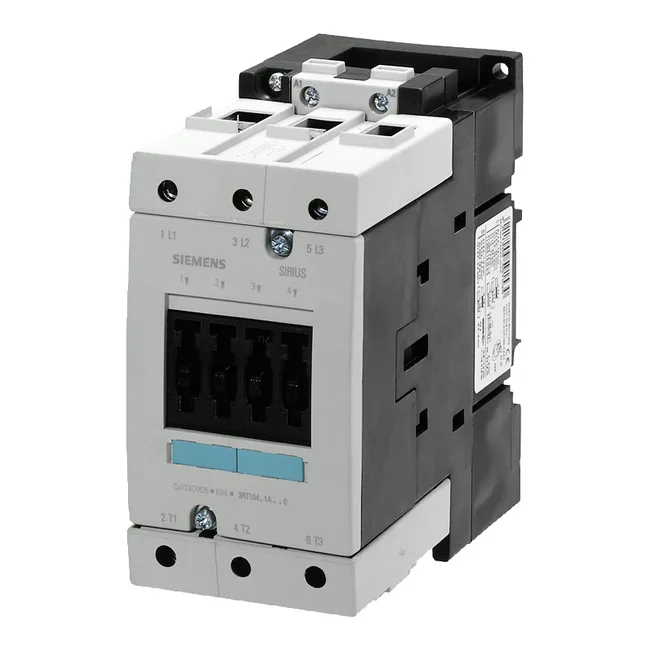
It carries a 55 A AC-4 rating at 400 V for reversing or inching duty, and 30 kW AC-2 at 400 V for slip-ring motor starting. At 500 V it handles 37 kW, at 690 V it handles 18.6 kW — covering the common European motor voltage bands. The front carries IP20 protection with a cover or box terminal; the terminal area itself is IP00 — expect the panel enclosure to provide the overall IP rating.
AC-4 at 400 V: 55 A. This is the rating that governs plugging and inching duty — the most demanding switching cycle for a contactor. AC-2 at 400 V: 30 kW. For slip-ring motor starting, where the rotor resistance is varied. Less severe than AC-4, but still a motor-switching duty that requires the contactor to handle inrush without welding contacts. AC-1 maximum mechanical switching frequency: 1 000 operations per hour. AC-3 maximum: 1 000 operations per hour. AC-4 maximum: 300 operations per hour. The AC-4 limit reflects the heavier arc erosion during reversing duty — plan your cycle rate accordingly. Coil draw at 24 V rated value: 10 A. At 230 V rated value: 6 A. At 400 V rated value: 3 A. These are the steady-state holding currents; inrush will be higher. The coil operates across 0.8 to 1.1 times rated voltage at 50 Hz.
Accepts solid conductors: 2x (0.5... 1.5 mm²), 2x (0.75... 2.5 mm²), max. 2x (0.75... 4 mm²). Stranded: 2x (10... 50 mm²). Solid or stranded: 2x (2.5... 16 mm²). The range covers control wiring up to motor power cables — no adapter lugs needed for standard European cable sizes. Dimensions: 70 mm width, 146 mm height, 139 mm depth. The S3 frame size is the largest in the SIRIUS contactor family; plan for the panel depth to clear the 139 mm projection, especially with cable bending radius behind the terminals.
RoHS compliance date: 05/01/2012. The part meets the substance prohibitions under the RoHS directive as of that date. Operating temperature: -25 to +60 °C. Storage temperature: -55 to +80 °C. The storage range exceeds the operating range — that limit governs handling and transport, not running conditions.