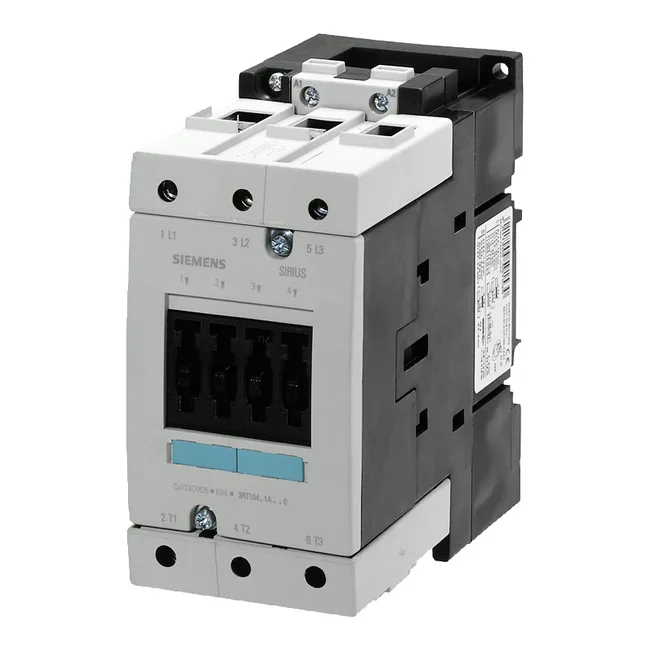
It carries a 30 kW AC-2 rating at 400 V for slip-ring motor duty and a 55 A AC-4 rating at 400 V for reversing or inching applications — the AC-4 figure is the one to watch if you are doing plugging or jogging, since that duty cycle generates the most contact wear. The coil draws 10 A at 24 V rated value, 2 A at 60 V, 1 A at 110 V, and 0.3 A at 220 V — these are the DC pickup currents; the AC coil versions pull 6 A at 230 V and 3 A at 400 V. Operating time on AC is 10 to 19 ms, with arcing time between 10 and 15 ms. That arcing window matters for contactor-coordination studies: if your upstream breaker or fuse clears faster than 10 ms, the arc may not extinguish inside the contactor.
Solid wire accepted: 2x (0.5 to 1.5 mm²), 2x (0.75 to 2.5 mm²), max 2x (0.75 to 4 mm²). Stranded wire: 2x (10 to 50 mm²). For mixed solid or stranded connections, 2x (2.5 to 16 mm²) covers the mid-range. The 50 mm² stranded capacity is generous for a size S3 — it lets you land a 70 A feeder without a ferrule or pin adapter, which saves panel space.
Pollution degree 3, so it is rated for the conductive-dust and condensation environment typical of unsealed industrial enclosures. Mechanical life is 10 million cycles typical. Maximum operating rates: 1000 cycles/hour for AC-1 and AC-3 duty, 400 for AC-2, and 300 for AC-4 — the lower AC-4 rate reflects the heavier arc erosion during reversing or inching.
Power Ratings by Voltage
At 500 V rated value the contactor delivers 37 kW; at 690 V it delivers 18.6 kW. These are motor-output figures — the actual line current depends on motor efficiency and power factor, but the contactor's thermal capacity is sized for the full-load current of a motor at those kW ratings.