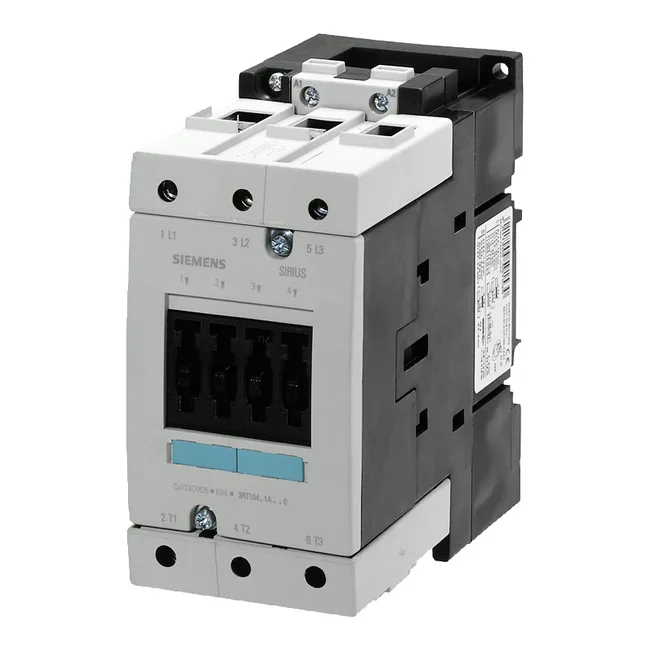
Siemens 3RT1044-1AP04-3MA0 — SIRIUS Size S3 Power Contactor
Its AC-4 rating of 55 A at 400 V governs plugging and inching duty — the most demanding switching category for contactors, where the motor is reversed or stopped by counter-torque. The AC-2 rating of 30 kW at 400 V covers slip-ring motor starting and braking.
For standard AC-3 motor starting (direct-on-line, no counter-torque), the contactor comfortably handles higher currents; the AC-4 limit is the binding constraint for reversing or braking applications. Mechanical endurance is 10 million operating cycles typical, with maximum switching rates varying by duty: 1 000 cycles/hour at AC-1 and AC-3, 400 at AC-2, and 300 at AC-4.
Solid conductors accepted: 2x (0.5 to 1.5 mm²), 2x (0.75 to 2.5 mm²), max 2x (0.75 to 4 mm²). Stranded conductors: 2x (10 to 50 mm²). Solid or stranded: 2x (2.5 to 16 mm²). These terminal ranges cover both control-circuit wiring (smaller gauges) and main power cabling (up to 50 mm² stranded), so the contactor can be wired directly to motor feeders without intermediate terminal blocks.