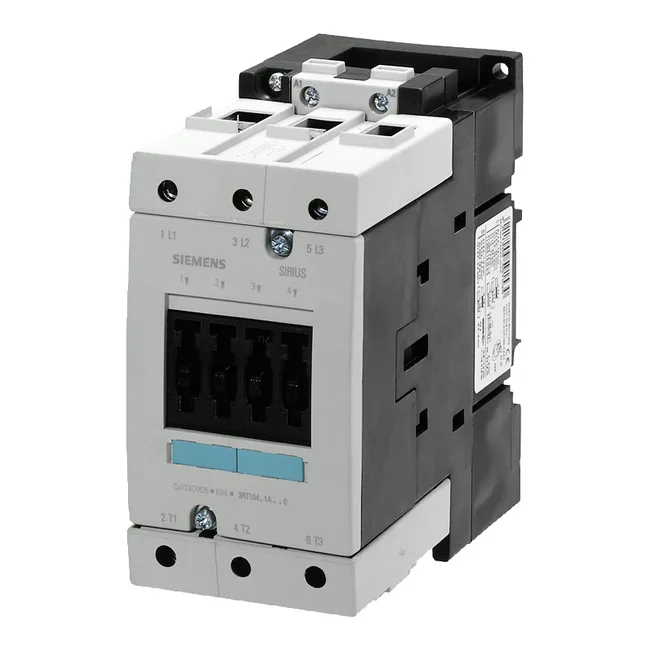
Its AC-3 rating of 37 kW at 500 V means it handles standard squirrel-cage motors up to that power — typical for pumps, fans, and conveyors on a 500 V line. At 690 V the motor rating drops to 18.6 kW, which is the derated figure for higher-voltage windings. The AC-4 rating of 55 A at 400 V governs plugging and inching applications — the most severe switching duty — so if your cycle includes rapid reversals, that 55 A figure is the one to size against, not the AC-3 kW number. Side-by-side mounting is permitted, which keeps the panel fill factor tight. The IP20 rating on the front with the cover or box terminal installed means it is finger-safe for panel interiors but not washdown-rated — keep it inside the enclosure.
Compliance documentation is in place: the substance prohibitance date of 05/01/2012 aligns with RoHS and REACH requirements.
Solid wire accepts 2x (0.5 to 1.5 mm²), 2x (0.75 to 2.5 mm²), or max 2x (0.75 to 4 mm²). Stranded wire takes 2x (10 to 50 mm²) for the main power connections. A separate solid or stranded range of 2x (2.5 to 16 mm²) covers auxiliary and control wiring. The terminal protection class is IP00 at the terminal itself — the IP20 front rating applies only with the cover or box terminal fitted, so keep the cover on during operation.
Switching rates and coil data
Maximum switching rates vary by duty: AC-1 (resistive) and AC-3 (motor starting) allow up to 1000 cycles per hour; AC-2 (slip-ring motor) allows 400 cycles per hour; AC-4 (plugging/inching) allows 300 cycles per hour. The coil draws 30 W at 1000 V rated value. The auxiliary contacts are rated for 10 A at 24 V, 2 A at 60 V, 1 A at 110 V, 0.3 A at 220 V, 6 A at 230 V, and 3 A at 400 V — these are the switching capacities for control circuits at those voltage levels.