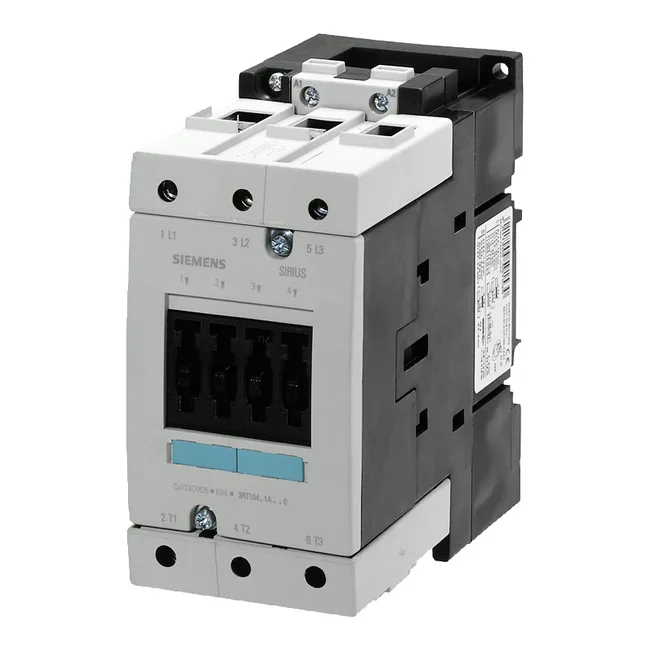
What it is and what it does
The Siemens 3RT1044-1BD44 is a SIRIUS power contactor in size S3, designed for switching motor loads in industrial control panels. It mounts via screw and snap-on onto 35 mm or 75 mm standard DIN rail, which means it drops into a standard panel layout without needing a custom bracket. The main current circuit uses screw-type terminals, so you're wiring with a standard screwdriver — no special crimp tool needed for the power connections. Solid wire sizes from 0.5 mm² up to 4 mm² are accepted on the control side, and stranded up to 50 mm² on the power side. Rated at 37 kW at 500 V and 18.6 kW at 690 V, this contactor handles typical three-phase induction motors in the 30–40 kW range on a 400 V line. The AC-4 rating at 400 V is 55 A, which matters for reversing or inching duty where the contactor makes and breaks the motor current at full load. Mechanical life is typical 10,000,000 operations. Side-by-side mounting is allowed.
Sourcing and lifecycle
RoHS compliance is dated 05/01/2012, meaning it meets the EU directive for restriction of hazardous substances. The operating temperature range is -25 to +60 °C, and storage range is -55 to +80 °C, so it's fine for most indoor panel environments but not for direct outdoor exposure without a heated enclosure.
What the ratings mean for fit
The AC-2 rating at 400 V is 30 kW — that's the duty for slip-ring motors or wound-rotor applications where the starting current is lower than a standard squirrel-cage. The AC-4 rating at 55 A is the heavy-duty number for plugging or inching; if your application does frequent reversing, that's the rating to size against, not the AC-3 figure. At 24 V DC the contactor can switch 10 A, but at 220 V DC that drops to 0.3 A — the DC switching capability is limited by arc extinction. If you're switching a DC load above a few amps, verify the voltage against the curve; this is primarily an AC switching device. The IP20 rating on the front with the cover or box terminal means it's protected against finger contact but not against water ingress. In a washdown environment, you'd need an enclosure around it.
