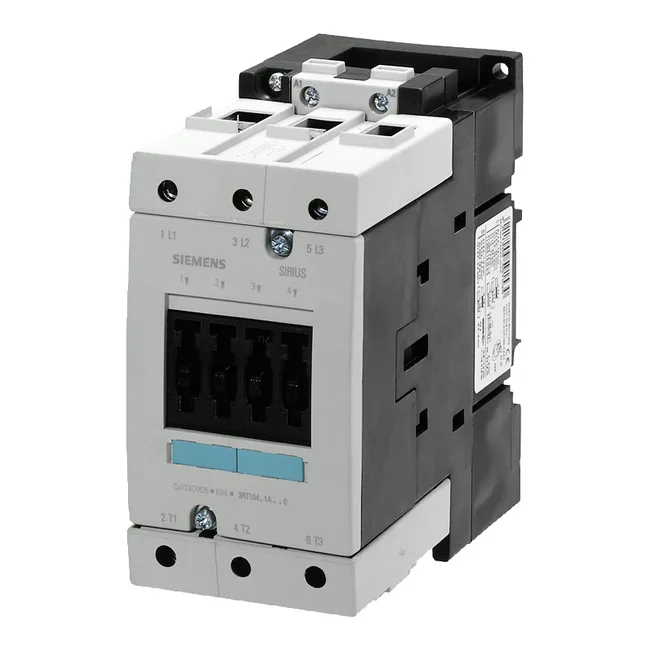
The 3RT1044-1QB44-3MA0: It snaps onto 35 mm or 75 mm standard mounting rail — screw and snap-on fastening — so it's a straight drop into any standard DIN-rail panel. The S3 frame size means it's built for motor loads up to around 37 kW at 500 V. IP20 on the front with the cover or box terminal fitted; the terminal area itself is IP00, which is typical for panel-mounted contactors — you're not running this exposed to washdown.
Physical footprint: 146 mm high, 70 mm wide, 201 mm deep. Wire terminations: solid conductors accept 2x (0.5 to 1.5 mm²), 2x (0.75 to 2.5 mm²), or max 2x (0.75 to 4 mm²). Stranded conductors go up to 2x (10 to 50 mm²). That's enough for the main power feeds on a motor circuit in this frame size. That covers most indoor panel environments without derating concerns unless you're near a furnace or on a roof in direct sun.
Switching capacity and duty cycles
For motor starting (AC-3 duty at 400 V), this contactor is rated at 30 kW. That's the number you care about for a standard three-phase induction motor — it tells you the contactor can handle the locked-rotor current and break the load under running conditions. In AC-4 duty (plugging, inching, reversing) at 400 V, it's rated at 55 A. That's a higher stress profile — frequent make-and-break under load — so the rating is lower than the AC-3 equivalent. Maximum switching rates: 1,000 cycles per hour for AC-1 and AC-3, 400 for AC-2, and 300 for AC-4. That's plenty for most process applications; only high-speed indexing or rapid reversing would push the AC-4 limit. Coil inrush at 24 VDC is 10 A initially, holding at 0.8 A after pickup. That's useful for timing coordination in safety circuits or sequential start schemes.
RoHS compliant with substance prohibition date of May 1, 2012 — that's the standard EU RoHS cutoff. The part carries the usual Siemens CE marking and is designed to IEC/EN 60947-4-1 standards for contactors. That's the no-load switching endurance; actual electrical life depends on the load current and duty cycle, but it gives you a benchmark for maintenance planning.