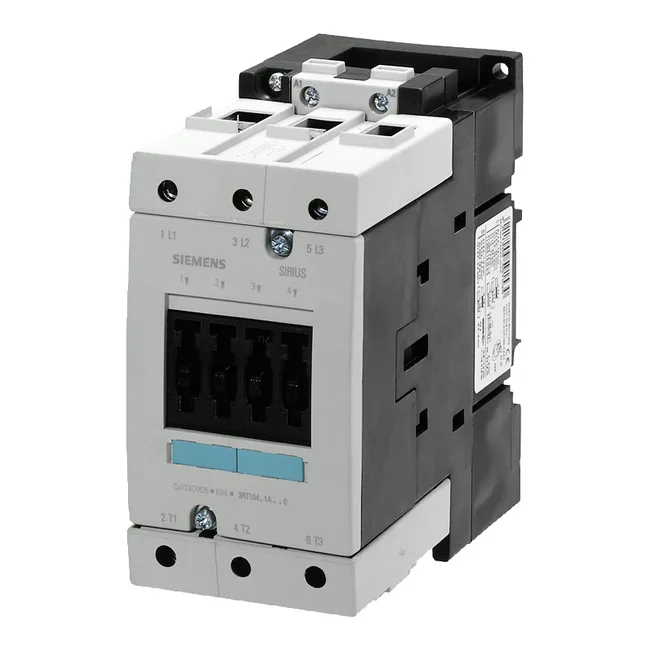
The headline motor-switching rating is 30 kW under AC-2 duty at 400 V — that's the category for slip-ring motors, wound-rotor drives, and other loads where starting current and switching frequency are moderate. For the heavier AC-4 duty (plugging, inching, reversing), it's rated 55 A at 400 V, which covers frequent jogging or reversing cycles without derating the contactor prematurely. The contactor carries a mechanical life of 10 million operations typical, and the electrical endurance varies by duty: up to 1,000 cycles per hour in AC-1 and AC-3, 400 cycles per hour in AC-2, and 300 cycles per hour in AC-4. That means it's built for continuous process lines where the contactor cycles several times a minute, not just a start-stop once per shift. The coil draws 10 A at 24 V rated value, with lower draws at higher control voltages — 6 A at 230 V, 3 A at 400 V, and 1 A at 110 V. The main circuit uses screw-type terminals, accepting solid conductors 2x (0.25 to 2.5 mm²) and stranded 2x (10 to 50 mm²). The IP20 front protection (IP20 on the front with cover or box terminal) means it's safe for finger contact in a closed panel, while the terminal itself is IP00 — so it requires enclosure protection against tools and debris.
The contactor carries a substance prohibitance date of 05/01/2012, indicating RoHS compliance (EU RoHS 2011/65/EU). That covers most indoor industrial installations, including non-conditioned electrical rooms in warm climates.