For DC switching, the contactor is rated 10 A at 24 V, 2 A at 60 V, 1 A at 110 V, and 0.3 A at 220 V — the current drops as voltage rises due to arc extinction limits in DC circuits. On AC motor duty, the contactor handles 37 kW at 500 V and 18.6 kW at 690 V. AC-2 duty (slip-ring motors, wound-rotor) is rated 30 kW at 400 V; AC-4 duty (plugging, inching) is rated 55 A at 400 V. These are the ratings that govern real motor switching — not the AC-1 resistive maximum.
Enclosure rated IP00; IP20 on the front with cover or box terminal. The contactor body relies on the panel enclosure for dust protection. Screw-type terminals on the main current circuit accept 2x (0.25...2.5 mm²) solid or 2x (10...50 mm²) stranded. The control circuit terminals accept 2x (2.5...16 mm²) solid or stranded. Strip length and torque values follow standard Siemens practice for the S3 frame.
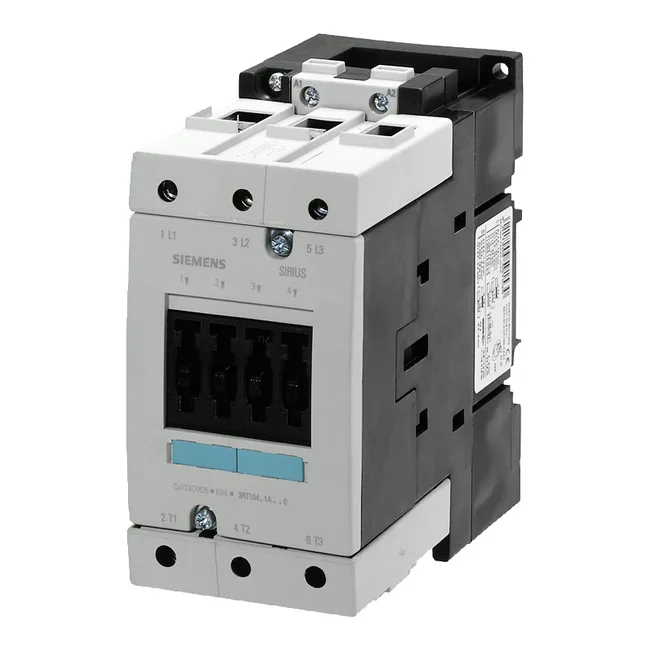
The part carries the SIRIUS brand designation and is designed to IEC/EN 60947-4-1 standards for contactors and motor starters.
Switching Performance
These timing figures matter for coordination in sequential switching or safety circuits where contactor overlap must be minimized. Maximum mechanical operating frequency is 10,000,000 cycles typical. Electrical switching rates: 1,000 cycles/hour at AC-1 and AC-3, 400 cycles/hour at AC-2, and 300 cycles/hour at AC-4. The AC-4 limit is the binding constraint for applications with frequent plugging or inching.