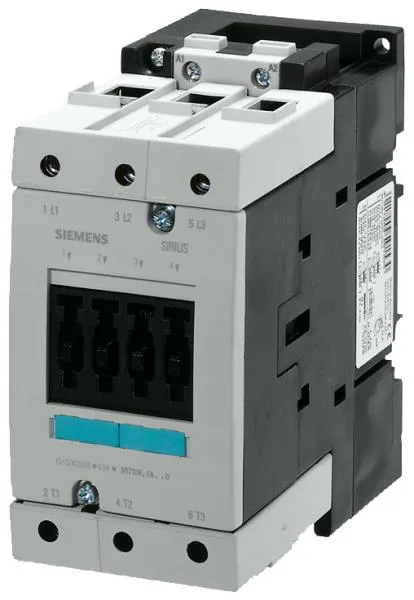
SIRIUS S3 Power Contactor — What This Rating Means for Your Panel
The Siemens 3RT1045-1AG60 is a SIRIUS S3-frame power contactor rated for 45 kW at 500 V AC-3 and 21.1 kW at 690 V AC-3 — those are the motor-switching numbers that govern real-world conveyor, pump, and fan loads. The AC-3 duty class means it's designed for starting and stopping squirrel-cage induction motors under full load, not just resistive heating banks. At 500 V it handles 45 kW; at 690 V the same contactor derates to 21.1 kW, so match your line voltage to the kW column, not the other way around. Mounting is screw-and-snap-on onto 35 mm or 75 mm standard DIN rail, which is the typical panel integration for this class. The front carries IP20 protection with the cover or box terminal installed; the terminal body itself is IP00, meaning the wiring compartment expects enclosure protection from the panel. Main circuit connections are screw-type terminals, sized for stranded cable up to 2x 50 mm² — that's a heavy power lug, appropriate for the S3 frame's current draw. Solid wire accepts 2x (0.5 to 1.5 mm²) for control wiring, with a separate 2x (2.5 to 16 mm²) range for the main power path.
What the IP and Terminal Ratings Mean for Fit
The IP20 rating on the front with cover installed means the operator-facing side is finger-safe, but the IP00 terminal rating means the wiring compartment must be inside a panel or enclosure that provides the environmental seal. This is standard for panel-mounted contactors — you're not bolting this open-frame into a washdown zone. The degree of pollution rating is 3, which covers conductive pollution in industrial atmospheres; expect this in a typical control panel with no aggressive dust or condensation.
Mechanical and Electrical Endurance
Mechanical life is typical at 10 million operations — that's the wear-out figure for the moving assembly, not the contacts. Electrical life depends on duty cycle: at AC-3 (motor starting) the maximum is 1,000 operations per hour; at AC-4 (plugging/inching) it drops to 300 per hour. The arcing time is 10 to 15 ms, and the dropout time at AC is 10 to 25 ms — fast enough for most safety circuits but verify coordination with your upstream breaker if you need Type 2 coordination.