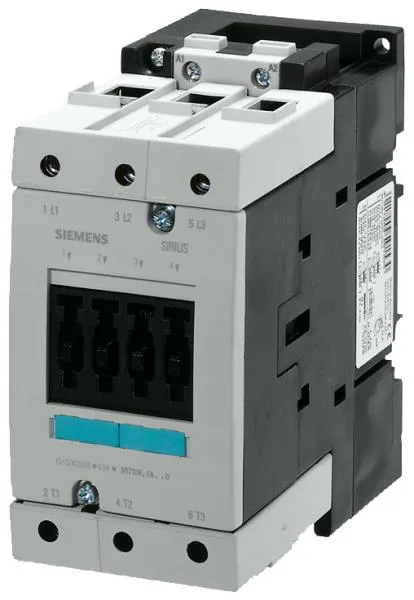
What This Part Is and Where It Fits
The Siemens 3RT1045-1AP64 is a SIRIUS power contactor in the size S3 frame, designed for switching three-phase motor loads in industrial control panels. It mounts on 35 mm or 75 mm standard DIN rail via screw or snap-on fastening, which simplifies panel integration and retrofit work. Rated for AC-3 duty at 45 kW on a 500 V 50/60 Hz supply, and 21.1 kW at 690 V, this contactor handles typical motor loads like pumps, fans, and conveyors up to that power band. The AC-3 rating is the one that matters for motor switching — it governs the make/break of locked-rotor currents.
Key Ratings and What They Mean for Fit
The 45 kW rating at 500 V (AC-3) is the headline number for motor selection. If your motor nameplate is 45 kW or less on a 500 V line, this contactor has the thermal and switching capacity. At 690 V the rating drops to 21.1 kW — that's the voltage derating curve, not a flaw. Always match the AC-3 rating, not the AC-1 resistive rating, for motor loads. Main circuit connections use screw-type terminals, sized for solid conductors up to 2x 4 mm² and stranded up to 2x 50 mm². That covers most motor feeder cables up to about 35 mm² per phase. The control circuit (coil) terminals accept 2x 0.5 to 2.5 mm² solid or stranded. IP20 on the front with the cover or box terminal installed means the panel builder must provide overall enclosure protection — the contactor itself is finger-safe from the front but not sealed against dust ingress. Pollution degree 3 confirms it's rated for conductive environments typical in industrial enclosures.
Mounting and Integration
Fastens to 35 mm or 75 mm DIN rail — the 75 mm option is less common but useful for high-current panels where standard 35 mm rail might flex. Side-by-side mounting is allowed, so multiple contactors can pack tightly on the rail without derating, as long as ambient stays within -25 to +60 °C operating range. Dimensions: 70 mm wide, 146 mm tall, 188 mm deep. That depth includes the arc chamber and terminal clearance — verify panel depth clearance before committing the layout, especially in shallow enclosures.
