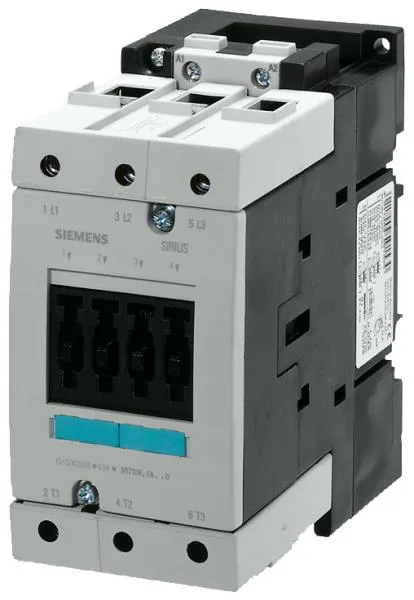
Its 24 V DC coil (rated value 24 V) picks up at 0.8 x Us and drops out at 1.1 x Us, with a DC arcing time of 14 to 20 ms and an AC arcing time of 10 to 15 ms — the DC arcing characteristic matters when breaking inductive DC loads, where the arc extinguishes slower than on AC. Rated for AC-3 duty at 45 kW on 500 V and 21.1 kW on 690 V, this contactor handles the motor starting and running currents typical of pumps, fans, and compressors in the 30–60 hp range on 400 V systems.
Main circuit terminals are screw-type, accepting solid conductors 2x (0.5 to 1.5 mm²), 2x (0.75 to 2.5 mm²), max 2x (0.75 to 4 mm²), and stranded conductors 2x (10 to 50 mm²) and 2x (2.5 to 16 mm²). The IP20 rating on the front with cover or box terminal means the contactor is finger-safe once installed in an enclosure; the terminal body itself is IP00, so live parts are exposed until the enclosure door is closed.
The substance prohibition date of 05/01/2012 aligns with RoHS compliance; expect REACH and RoHS documentation with the shipment.
DC Switching Capability
The contactor is rated for DC switching at several voltage levels: 10 A at 24 V, 2 A at 60 V, 1 A at 110 V, and 0.3 A at 220 V. These ratings are for resistive DC loads; inductive DC loads (solenoids, DC motor brakes) require derating or arc-suppression measures because the DC arcing time of 14 to 20 ms is longer than the AC arcing time.
Mechanical Endurance
Typical mechanical life is 10 000 000 operations. Electrical life depends on the duty cycle: AC-1 (resistive) allows 900 operations per hour, AC-2 (slip-ring motors) 400 ops/h, AC-3 (squirrel-cage motors) 1 000 ops/h, and AC-4 (reversing/inching) 300 ops/h. The mechanical life figure means the contactor itself will outlast most motor-driven equipment in normal service.