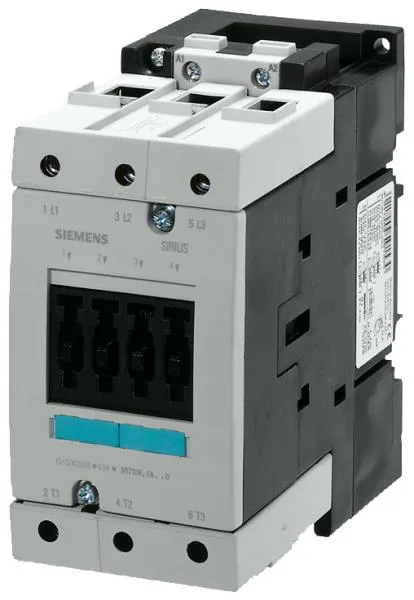
The 3RT1045-1BD40: The main current circuit uses screw-type terminals, accepting stranded conductors from 2x (10... 50 mm²) and solid conductors in multiple ranges: 2x (0.5... 1.5 mm²), 2x (0.75... 2.5 mm²), and max. 2x (0.75... 4 mm²). Auxiliary contacts are rated 10 A at 24 V, 2 A at 60 V, 1 A at 110 V, and 0.3 A at 220 V — these are the switching capacities for control circuits, not the main power path.
Dimensions are 146 mm height, 70 mm width, and 152 mm depth — the depth is the dimension that extends into the enclosure, so a 200 mm deep panel leaves roughly 48 mm behind the contactor for wiring and bending radius. Front protection is IP20 with the cover or box terminal installed; the terminal area itself is IP00.
Maximum switching frequency varies by duty: 900 cycles/hour at AC-1 (resistive), 400 at AC-2, 1000 at AC-3, and 300 at AC-4.