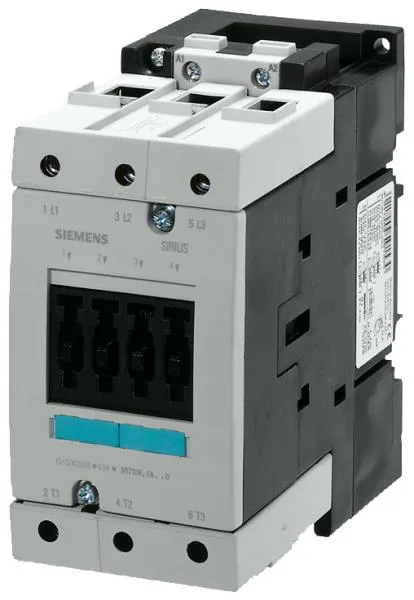
What This Contactor Does and Where It Fits
It mounts on standard 35 mm or 75 mm DIN rail using the screw-and-snap-on fastening method, or can be screw-mounted directly to a backplate. The main current circuit uses screw-type terminals, which is the standard termination for panel builders who prefer secure, serviceable connections over spring-clamp. Solid wire capacity goes up to 2x (0.75... 4 mm²) maximum, and stranded accepts 2x (10... 50 mm²), so it handles the heavier power feeds typical of an S3 contactor.
That 66 A figure tells you the contactor can handle the electrical wear of frequent plugging or jogging without welding contacts. For standard motor starting (AC-3), this contactor switches up to 45 kW at 500 V and 21.1 kW at 690 V, covering the bulk of three-phase induction motors in the 30-60 hp range depending on line voltage. The AC-2 rating of 37 kW at 400 V covers slip-ring motor duty where the rotor circuit is switched. Mechanical life is typical at 10 million operations, and the AC-3 switching rate maxes at 1,000 cycles per hour — fast enough for most conveyor or pump cycling, but not for high-speed pick-and-place. The AC-4 rate drops to 300 cycles per hour, reflecting the heavier arc wear in that duty.
Environmental Fit and Protection
RoHS compliance is documented with a substance prohibition date of May 1, 2012, so it meets the EU directive for lead and other restricted substances. No special compliance documentation beyond the standard declaration is needed for most industrial installations.
Dimensions are 70 mm wide, 146 mm high, and 152 mm deep — a compact S3 footprint that fits alongside other SIRIUS components on the same DIN rail. The auxiliary contact block options (not included with this base unit) share the same coil suppression as the main contactor. If you're adding aux contacts downstream, verify free-wheel diode polarity before energizing inductive loads — standard practice for any DC-suppressed coil circuit.