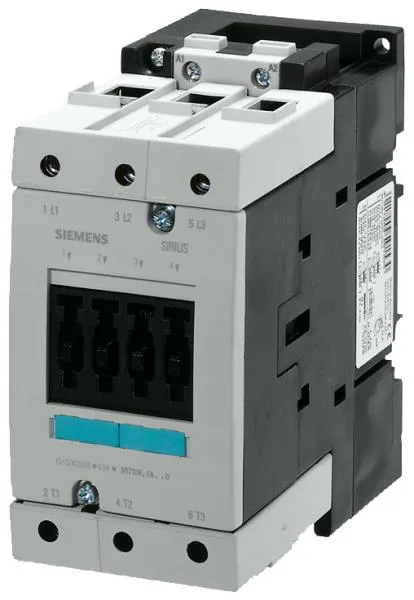
What This Contactor Delivers on the Line
The Siemens 3RT1045-3BB44-3MA0 is a SIRIUS size S3 power contactor rated for 37 kW at 400 V in AC-2 duty — the standard for slip-ring motor starting and reversing. If your line uses jogging or reversing on conveyors or hoists, the AC-4 figure is the one that decides contact life. Coil is 24 V DC, pulling 0.8 A on pickup. That's a standard PLC-level control voltage — no separate power supply needed if your cabinet already runs 24 VDC.
Panel Fit and Clearance
Footprint is 70 mm wide by 146 mm tall by 201 mm deep. That depth is the one that catches panel builders — it's deeper than a typical S2 contactor, so verify gland-plate clearance and door swing before laying out the backplane. Side-by-side mounting is allowed, which helps when you're stacking multiple contactors on a motor control center bus. Terminals are screw-type on the main circuit, accepting 2x (10–50 mm²) stranded or 2x (0.25–2.5 mm²) solid. The auxiliary circuit handles 2x (2.5–16 mm²) solid/stranded. If your panel sits near a furnace line or in an unheated warehouse, the -25 °C floor is fine for most plants; the +60 °C ceiling handles interior cabinet heat rise without forced ventilation.
Switching Cycles and Contact Life
Mechanical life is a typical 10 million operations — that's the contactor frame, not the contacts. Electrical life depends on duty: at AC-3 (standard squirrel-cage motor start/run) you get up to 1,000 cycles per hour; at AC-4 (inching/jogging) it drops to 300 cycles per hour.
This is a quoted-to-order item through distribution. The SIRIUS series is widely stocked, but the -3MA0 variant may not sit on every distributor's shelf. Send an RFQ with your quantity and target delivery window.