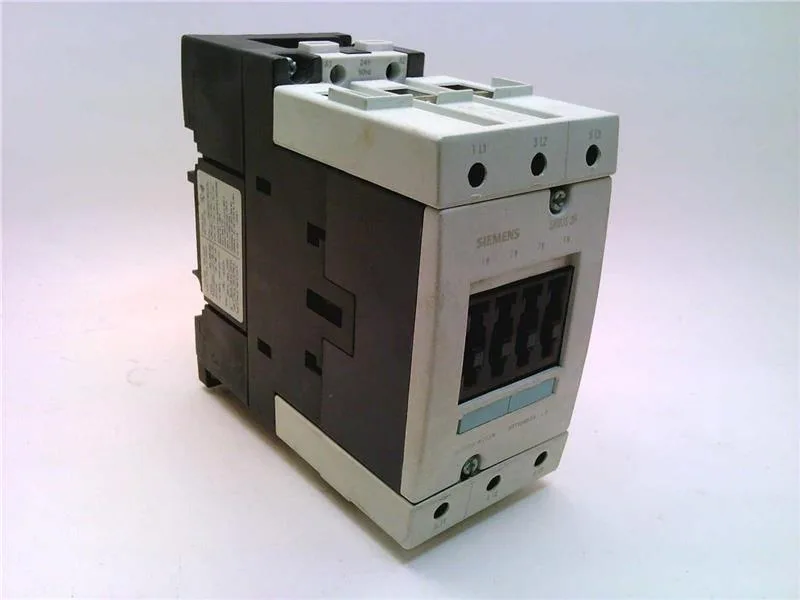
It carries a 55 kW rating at 500 V and 25.4 kW at 690 V, so it handles medium-horsepower pumps, fans, and compressors on 400 V or 690 V distribution. The coil pulls 48 V at 50/60 Hz, with an operating range of 0.8 to 1.1 times rated voltage at 50 Hz and 0.85 to 1.1 at 60 Hz — that gives you a solid pick-up margin even if the control transformer sags under load.
Mounting and wiring reality
Main circuit terminals are screw-type, accepting solid conductors up to 2x (0.75... 4 mm²) per clamp and stranded up to 2x (10... 50 mm²). The front carries IP20 with the cover or box terminal fitted; the terminal body itself is IP00, meaning the live parts are exposed until the enclosure lid is on — standard for panel-mount contactors, but something to flag for the wireman during commissioning.
Switching duty and mechanical endurance
Rated for 10,000,000 mechanical operations typical — that is the contactor body itself, not the contacts under load. Electrical life depends on the duty class: AC-1 (resistive) allows up to 900 switching cycles per hour, AC-3 (squirrel-cage motor start/run) allows 850 per hour, AC-2 (slip-ring motor) drops to 350, and AC-4 (plugging/inching) is limited to 250 per hour. For a conveyor line running a motor start every 30 seconds, the AC-3 rate of 850 cycles/hour gives you headroom; for a reversing application with frequent plugging, the AC-4 limit is the one to watch.
Environmental and auxiliary ratings
Operates from -25 to +60 °C, stores from -55 to +80 °C — fine for unheated panel sheds in northern climates as long as the cabinet stays above -25. Auxiliary contact ratings: 10 A at 24 V, 6 A at 230 V, 3 A at 400 V — these are the figures to use when sizing the control circuit fusing, not the main contactor rating.