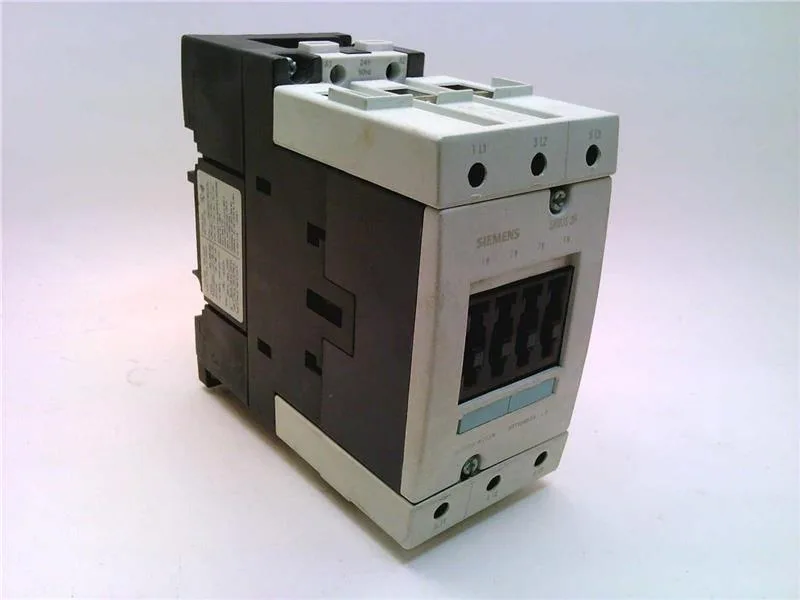
For AC-4 duty (plugging, inching, reversing), the rated operational current is 80 A at 400 V, which governs the thermal stress during high-frequency reversing cycles. At 500 V it is rated for 55 kW, and at 690 V for 25.4 kW, covering the common European and North American line voltages. For DC switching, the contactor is rated at 10 A at 24 V, 2 A at 60 V, 1 A at 110 V, and 0.3 A at 220 V — these values drop rapidly with voltage, so verify the DC load curve if your circuit is not resistive. The IP20 rating on the front with cover or box terminal means finger-safe protection from the front; the terminal area itself is IP00, so live parts are exposed during wiring — standard for panel-mount contactors. Power dissipation is 37 W at 1000 V — relevant for thermal management inside a sealed enclosure.
Main power circuit uses screw-type terminals. The contactor accepts solid conductors from 2x (0.5 to 1.5 mm²) up to max 2x (0.75 to 4 mm²) for control wiring, and stranded conductors from 2x (2.5 to 16 mm²) up to 2x (10 to 50 mm²) for the main circuit. That range covers most panel wiring from control circuits up to 50 mm² motor feeders.
Mechanical life and switching frequency
Maximum switching frequency varies by duty: 900 cycles per hour at AC-1 (resistive), 850/h at AC-3 (motor starting), 350/h at AC-2, and 250/h at AC-4 (reversing).