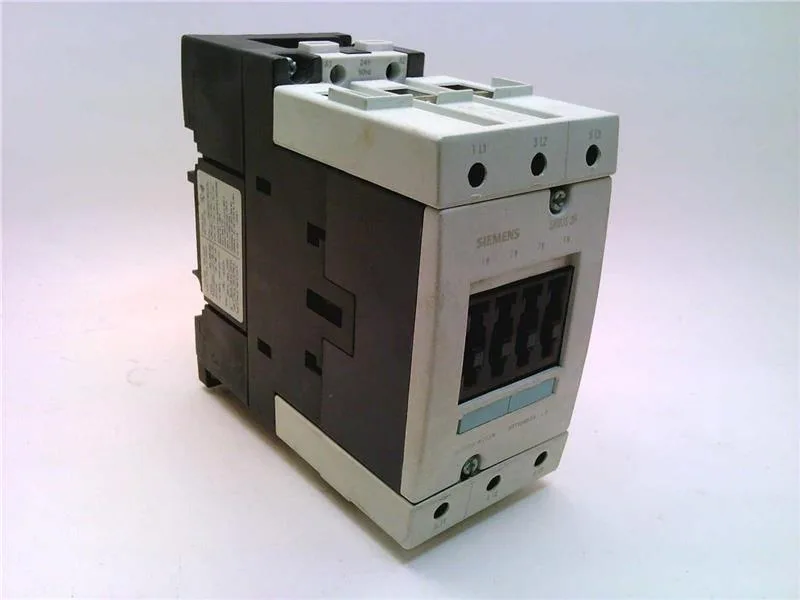
The Siemens SIRIUS 3RT1046-1XX10-0UA8 is a size S3 power contactor rated 45 kW at 400 V in AC-2 duty — the category for slip-ring motor starting, where the contactor makes and breaks the rotor circuit under load. The 45 kW at 400 V AC-2 means this contactor handles a 45 kW slip-ring motor at 400 V without exceeding thermal limits during the longer arcing time of AC-2 (10–15 ms arcing time per). The contactor also carries a 55 kW rating at 500 V and 25.4 kW at 690 V, giving flexibility for different line voltages. The screw-type terminals for the main circuit accept solid or stranded conductors from 2x (2.5... 16 mm²) and up to 2x (10... 50 mm²) stranded, while the auxiliary/control terminals handle 0.5 to 4 mm². That covers most motor-circuit wiring up to 50 mm² without needing adapters.
The contactor measures 176 mm high, 70 mm wide, and 152 mm deep — the S3 footprint fits standard motor-starter slots. The IP20 rating on the front (with cover or box terminal) means finger-safe touch protection in a closed panel; the terminal area itself is IP00, so live parts are exposed during wiring and must be de-energized. Auxiliary contact ratings span from 10 A at 24 V down to 0.3 A at 220 V, covering both 24 VDC control circuits and higher-voltage pilot duties. The mechanical life is typical 10 million operations, and the maximum switching frequency ranges from 900 cycles/hour at AC-1 to 250 cycles/hour at AC-4 — the AC-4 limit is the one to watch for plugging or inching duty. The coil operates on 50/60 Hz with a tolerance of 0.8 to 1.1 times rated voltage, so it handles the typical ±10% supply variation. Vibration resistance is 10.6g at 5 ms and 6.2g at 10 ms — adequate for most industrial panels but not for direct mounting on high-vibration machinery without isolation.