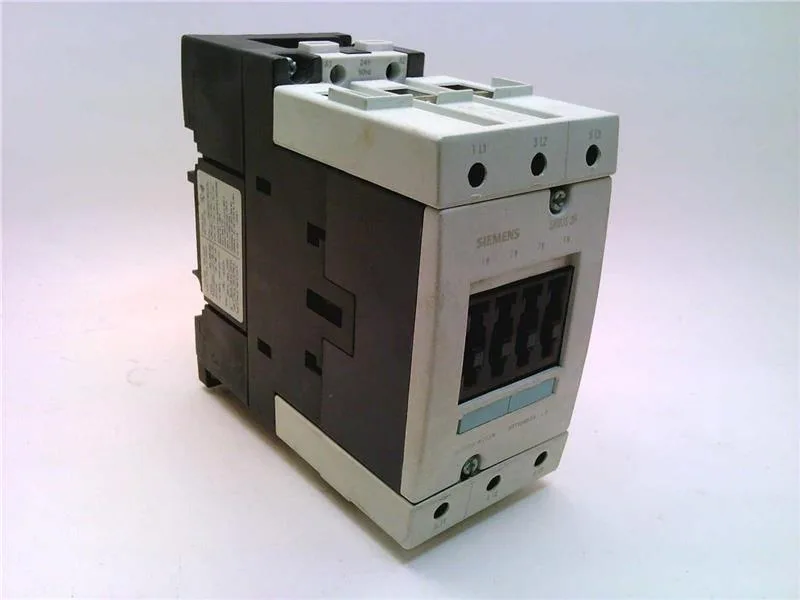
Its headline rating is 55 kW at 500 V AC-3, which is the motor-switching duty class per IEC 60947-4-1 — that's the rating that governs real-world motor starting and stopping, not the higher resistive (AC-1) figure. It also carries a 25.4 kW rating at 690 V AC-3, so it handles 690 V line supplies common in European and export panels. Screw-type terminals on the main circuit accept solid conductors from 0.25 to 2.5 mm² (2x) and stranded conductors from 10 to 50 mm² (2x). That covers most motor feeder cables up to 50 mm² without needing lug adapters.
Switching frequency and auxiliary contact ratings
Maximum switching frequency varies by duty: 900 cycles/hour at AC-1 (resistive), 850 at AC-3 (motor), 350 at AC-2 (slip-ring motor), and 250 at AC-4 (plugging/inching). For a conveyor running at 30 starts/hour, AC-3 headroom is ample; for a high-cycle press brake, the AC-4 limit may govern selection. The integrated auxiliary contact block is rated 10 A at 24 V, 6 A at 230 V, and 3 A at 400 V — these are the make/break capacities for the control circuit. If you're driving a PLC input or a small relay coil at 24 VDC, the 10 A rating gives plenty of margin; at 400 VAC for a contactor coil, the 3 A rating still covers most standard coils.
Degree of pollution 3.
Sourcing and fit considerations
This is a quoted-to-order line item. Submit an RFQ with your quantity and target delivery window. If your panel was specified around the 3RT1044-1FB46, the 3RT1046-3AN60 will not drop in without checking the coil voltage and auxiliary contact configuration.