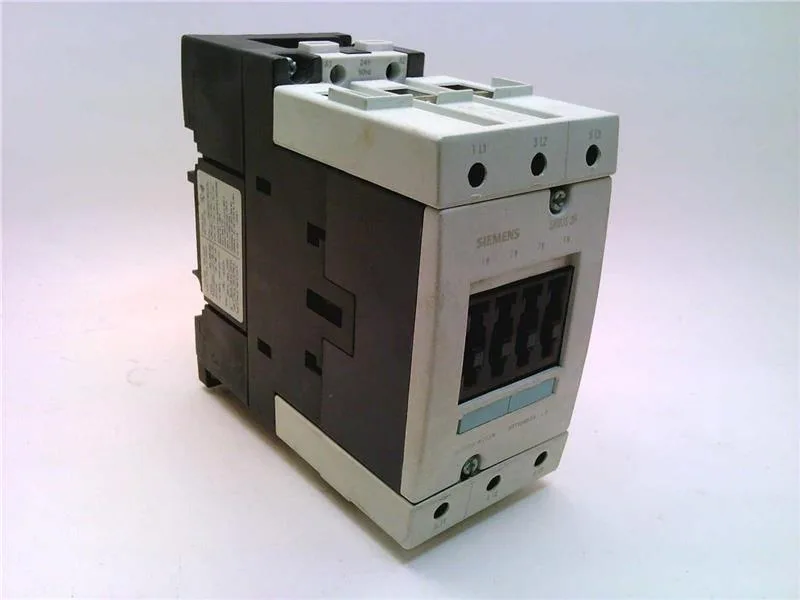
The Siemens 3RT1046-3AV00 is a SIRIUS power contactor in frame size S3, rated for motor switching at 55 kW on a 500 V AC-3 line — that's the duty cycle for starting and running a standard three-phase induction motor under full load. At 690 V AC-3 the rating drops to 25.4 kW, so if your motor plate says 690 V, this contactor handles that load class. The AC-4 rating at 400 V is 80 A, which governs plugging and inching duty where the contactor makes and breaks stalled-rotor current; that's a harder thermal cycle than AC-3, and the 80 A figure tells you the contactor is sized for that abuse without derating. Mounting is screw-and-snap-on onto standard 35 mm or 75 mm DIN rail, and side-by-side mounting is permitted — no derating gap required between units in a row. That saves panel width when you're stacking contactors for multiple motor starters. The terminal enclosure is rated IP20 on the front with the cover or box terminal fitted, IP00 at the terminal itself, so it's a panel-interior part; no washdown rating, no outdoor use without an additional enclosure.
Main circuit terminals are screw-type, accepting solid conductors 2x 0.25 to 2.5 mm² for control wiring, and stranded conductors 2x 10 to 50 mm² for the power loop.
The 3RT1044-1FB46 is a smaller S2-frame contactor, roughly one frame size down. The 3RT1046-3AV00 (S3) carries higher current ratings — 55 kW at 500 V AC-3 vs the S2's lower power band — and accepts larger stranded conductors (50 mm² vs the S2's typical 25 mm² max). If your existing panel was built around the 3RT1044-1FB46, the 3RT1046-3AV00 will not drop in without rewiring: the S3 frame is wider (70 mm vs S2's 55 mm), the terminal spacing is different, and the mounting hole pattern on the rail clip is the same but the overall footprint grows. You'd need to re-lay out the DIN rail section and re-terminate the power cables. For a like-for-like swap, stick with the same frame size; for an upgrade to handle a larger motor, the S3 is the right move but plan for panel rework.
RoHS compliance date is May 1, 2012, so the part meets the EU directive for new equipment placed on the market after that date.