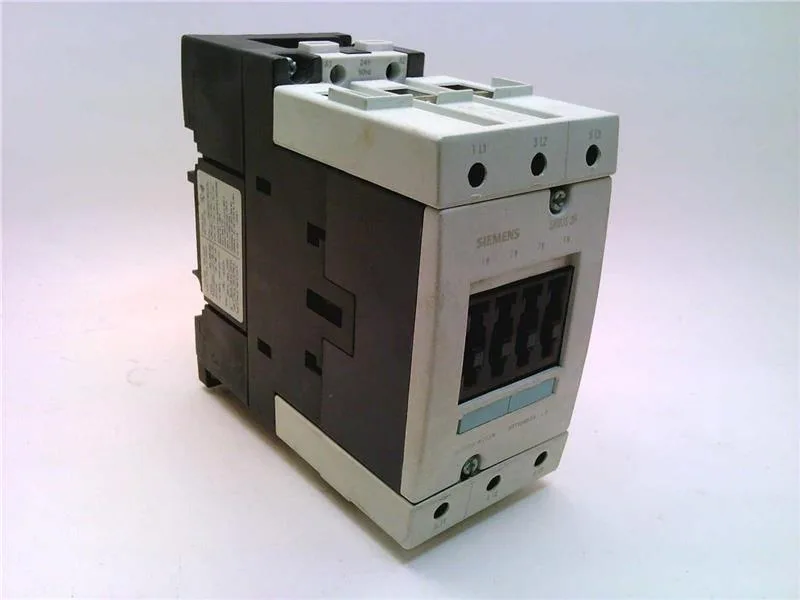
It mounts on standard 35 mm or 75 mm DIN rail using the screw-and-snap-on method, so it drops into any modern panel without custom bracketing. The screw-type main circuit terminals accept solid wire from 0.25 to 2.5 mm² (two conductors) and stranded up to 50 mm², giving you flexibility on wire gauge without needing special lugs. Front protection is IP20 with the cover or box terminal fitted — enough to keep fingers and tools out during commissioning, but not sealed against washdown. The terminal area itself is IP00, so plan for enclosure-level ingress protection if this goes into a wet or dusty environment.
The coil pulls a steady 10 A at 24 VDC inrush, dropping to 0.8 A holding — that's the initial vs. full-scale value. At 60 VDC the inrush drops to 2 A, and at 220 VDC it's down to 0.3 A. This matters for your DC power supply sizing: a 24 VDC bus feeding multiple contactors needs headroom for the simultaneous inrush of all coils pulling 10 A each. The contactor is rated for 55 kW at 400 V and 25.4 kW at 690 V — typical three-phase motor loads. The AC-3 switching frequency tops out at 850 operations per hour, which covers most conveyor and pump duty cycles without overheating. If you're doing frequent reversing or plugging (AC-4), that drops to 250 ops/h, so plan accordingly. That means it's fine in a non-conditioned enclosure on the plant floor, but if it's sitting next to a furnace or oven, watch the ambient. The degree of pollution is 3 — conductive pollution is expected, so it's built for industrial environments, not clean rooms.
The substance prohibitance date of 05/01/2012 confirms RoHS compliance for EU markets. No special documentation chase needed for cross-border sourcing — it carries the standard Siemens compliance package.
At 70 mm wide, 146 mm tall, and 201 mm deep, this S3 frame contactor is sized for a standard 200 mm deep enclosure — no need for a deep back-panel. That's fast enough for most interlocking and safety circuits, but if you're coordinating with upstream breakers or fuses, make sure the short-circuit rating of your protective device clears before the contactor welds shut.