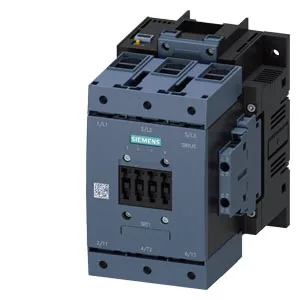
It includes a factory-fitted auxiliary switch block, saving a panel-building step on installation.
Duty-cycle and switching frequency
Switching frequency depends on the duty class: AC-1 (resistive) allows up to 800 operations per hour, AC-3 (squirrel-cage motor starting) allows up to 1 000 ops/h, AC-2 (slip-ring motor) caps at 400 ops/h, and AC-4 (plugging/inching) drops to 130 ops/h. The AC-3e rating also permits 1 000 ops/h. For a packaging line running frequent starts and stops, the AC-4 limit is the binding constraint — plan for that if the contactor sees inching duty.
Coil pickup is guaranteed at 80 % of rated voltage; dropout occurs at 60 % (typical) and full-scale dropout at 1.1× rated. Operate time is 80-90 ms on both AC and DC supplies. Arcing time runs 10-15 ms. The auxiliary contacts are rated for 10 A at 24 V, 2 A at 48/60 V, 1 A at 110 V, 0.9 A at 125 V, and 0.3 A at 220 V — useful for driving a PLC input or a smaller relay directly.
Fastened by screw fixing, not DIN-rail snap-on. Main power terminals accept stranded wire from 16 to 70 mm². Auxiliary terminals accept 2× (0.5-1.5 mm²) solid, 2× (0.75-2.5 mm²) solid, or max 2× (0.75-4 mm²) stranded. Dimensions: 172 mm high, 120 mm wide, 170 mm deep.