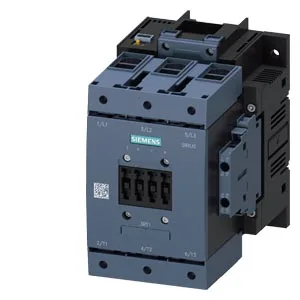
The 3RT1054-1XB46-0LA2: The coil is rated 24 VDC with a holding current draw of 6 A at that voltage, so the control transformer or DC power supply feeding it needs to be sized for that inrush and seal current. Physically it measures 172 mm high by 120 mm wide by 170 mm deep, mounts via screw fixing, and requires 10 mm clearance upwards, downwards, and to the side, plus 20 mm forward — a standard panel layout consideration when spacing multiple contactors on a backplate.
Ratings that matter for the application
The 6-pole configuration (six main contacts) means this contactor can switch three-phase loads with a spare pole for each phase, or handle two independent three-phase loads. It carries an auxiliary switch as standard, which is useful for feedback to a PLC or for electrical interlocking. Maximum switching rates are specified per duty class: 1,000 operations per hour in AC-3 (standard squirrel-cage motor switching) and AC-3e, 800 in AC-1 (resistive), 400 in AC-2 (slip-ring motor), and 130 in AC-4 (plugging/reversing). The AC-4 rate is the binding constraint for applications requiring frequent inching or reversing — plan the duty cycle around that 130 ops/h ceiling. Mechanical life is rated at 10 million operations typical, which for a contactor running at 1,000 ops/h in AC-3 duty translates to roughly 10,000 hours of continuous cycling before mechanical wear becomes a concern.
Main power terminals accept stranded conductors up to 2x 70 mm², so this contactor handles heavy cable for high-current motor circuits without needing lug adapters. The auxiliary/control terminals accept 2x (0.5 to 1.5 mm²) solid or 2x (0.75 to 2.5 mm²) stranded, with a maximum of 2x (0.75 to 4 mm²). Mounting is via screw fixing through a single 9 mm diameter hole — not a DIN-rail clip, so plan for a drilled backplate or a sub-panel with the hole pattern laid out.