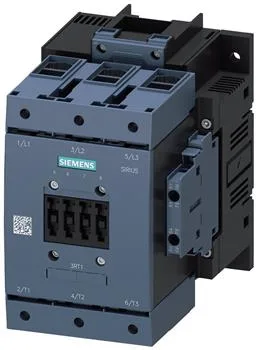
The S6 frame covers motor loads up to the current limit defined by the utilization category. Main power terminals accept stranded cable up to 120 mm², which is generous for the frame size and covers most motor feeder requirements without a separate terminal block. That covers most panel layouts, including top-entry cable trays where the contactor sits rotated 90° from the standard orientation.
Duty-cycle capacity — what the switching-frequency ratings mean
This contactor is rated for 1,000 cycles per hour in AC-3 and AC-3e duty. For AC-1 resistive loads it is 800 cycles/hour, and for AC-4 it drops to 130 cycles/hour. That's typical for a contactor this size — fast enough for most motor starting but not for precision switching of resistive loads where zero-crossing matters.
The auxiliary switch is included — it's not a separate add-on module. That saves a catalog number and a DIN slot if you need one N/O + one N/C for feedback or interlocking. Auxiliary contact ratings are 10 A at 24 V, 2 A at 48 V, 2 A at 60 V, and 1 A at 110 V — adequate for PLC inputs and relay coils in the same panel.
Panel integration — dimensions and clearances
The envelope is 172 mm high, 120 mm wide, 170 mm deep. That's a Size S6 footprint — it needs a backplate area roughly 172 x 120 mm, plus clearance for cable bending and arc flash. The forward clearance of 20 mm is the one that catches people — if you're mounting a gland plate or a cover closer than that, you're outside the spec. Fastening is via screw fixing through a single 9 mm diameter hole. That's a single-point mount — not a four-corner bolt pattern — so the backplate needs to be rigid enough to prevent the contactor from twisting under cable pull.