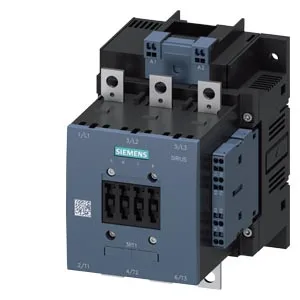
It's rated for up to 1000 operating cycles per hour in AC-3 duty (full motor switching), which matches the pace of a conveyor line or pump station where the contactor cycles every few seconds. The auxiliary contact block handles 10 A at 24 V and 2 A at 48/60/110 V (–), so it can directly drive a PLC input or a small relay without an interposing stage. That saves a DIN rail slot and keeps the wiring tidy.
The contactor measures 172 mm high by 120 mm wide by 170 mm deep. It fixes to the panel with a single 9 mm screw hole. The mounting position is flexible: vertical surface, rotatable ±90°, and tiltable ±22.5° front-to-back. That helps when the panel layout is tight and you need to angle the contactor to clear a busbar or another device. That leaves room for cooling and wiring access without wasting panel depth.
The AC-3 switching rate of 1000 operations per hour is the number that governs real motor duty — it's the full-load make-and-break rating, not the lighter AC-1 resistive rate. If your application cycles faster than once every 3.6 seconds, you'll need to step up to a larger frame or add a soft starter. The AC-4 rate (130 ops/h) is for plugging and inching, where the contactor breaks locked-rotor current — that's a tougher duty, and the lower number reflects it. The arcing time of 10–15 ms and total opening time of 40–60 ms are consistent with a standard electromechanical contactor — fast enough for motor protection coordination, but not a semiconductor-grade speed.