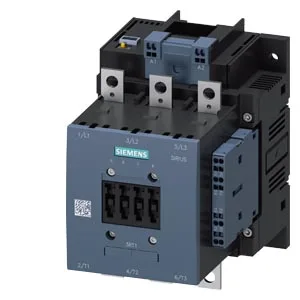
It mounts via screw fixing to a vertical surface, with ±90° rotatability and ±22.5° tilt front-to-back, so it adapts to tight enclosure layouts without custom bracketry. The coil connection uses spring-type terminals — no screwdriver needed for the control wiring, which speeds up panel assembly and reduces torque-check steps during commissioning.
The auxiliary contact circuit is rated 10 A at 24 V, 2 A at 48 V and 60 V, and 1 A at 110 V — these are the switching limits for the feedback or interlock loop, not the main pole current. If your PLC input card expects a 24 V signal at 50 mA, this contact handles it with headroom; the 1 A at 110 V covers legacy relay logic drops. Mechanical life is quoted at 10,000,000 operations typical, which for a conveyor line cycling once every 30 seconds gives roughly 9.5 years of continuous service before mechanical wear becomes a consideration. The switching rates per duty class tell you the thermal limit per hour: AC-1 (resistive) allows 800 cycles/h, AC-3 (squirrel-cage motor start/run) allows 1,000 cycles/h, and AC-4 (plugging/inching) drops to 130 cycles/h — the severe duty rating governs inching applications.
Dimensions: 172 mm high, 120 mm wide, 170 mm deep. The S6 frame is the physically largest in the SIRIUS contactor range — verify backpanel clearance, especially depth, before committing the layout. The screw-fixing holes are 9 mm diameter, single hole per corner, matching standard M8 hardware. If the panel sits near a furnace line or in a non-conditioned cabinet, the -25 °C low end covers most cold-start scenarios; the 60 °C upper limit means derating is needed above that ambient.