What Fits Where
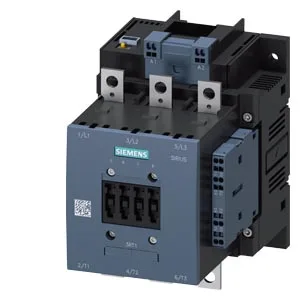
The 3RT1054-2XJ46-0LA2: Size S6 frame, 172 mm tall, 120 mm wide, 170 mm deep. That depth is the dimension you'll need to check against your enclosure back-panel clearance — especially if you're retrofitting into an older cabinet where the gland plate or door-mounted components eat into that space. Mounting is screw-fix, not DIN rail, so budget for drilling and tapping the backplate. The contactor can be mounted on a vertical surface and rotated ±90°, or tilted ±22.5° forward/backward, which gives you some play when aligning with busbars or existing wiring troughs.
Auxiliary Contact Loads
Comes with an auxiliary switch block built in. The DC ratings on the aux contacts are what matter for PLC or relay interface circuits: 6 A at 24 V, 2 A at 48 V, 2 A at 60 V, 1 A at 110 V, 0.9 A at 125 V. If you're switching a 24 VDC relay coil or a small solenoid valve, the 6 A figure gives comfortable headroom. Don't push the 125 V/0.9 A line too close to the limit — inductive loads will arc longer than the 10–15 ms arcing time suggests.
Operating Cadence
Switching frequency varies by duty class: 1 000 ops/hour under AC-3 (motor starting), 800 under AC-1 (resistive), 400 under AC-2, and 130 under AC-4 (plugging/inching). For DC loads, 500 ops/hour under DC-3 and DC-5, 400 under DC-1. If you're running a high-cycle pick-and-place or a conveyor that jogs frequently, the AC-4 limit of 130 ops/hour is the binding constraint — don't spec this for a rapid-reversing application without checking the thermal curve.