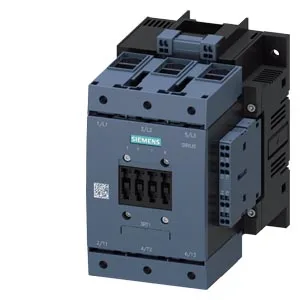
SIRIUS Size S6 power contactor — panel fit and conductor range
The 3RT1054-3AB36 is a Siemens SIRIUS power contactor in Size S6, meaning it occupies a defined footprint for panel layout: 172 mm high, 120 mm wide, 170 mm deep. Mounting is by screw fixing, not DIN rail snap-on, so plan for drilled holes and a fixed backplate. The mounting position allows the vertical surface to be rotated ±90° or tilted ±22.5° front-to-back, giving some flexibility in tight enclosures. Power-side conductors accept stranded wire from 16 to 70 mm² — this covers the main motor feed for a contactor this size. The auxiliary/control circuit uses spring-type terminals accepting 2x (0.25 to 2.5 mm²) solid or stranded wire. Clearance distances are specified: 10 mm upwards, 10 mm downwards, 20 mm forwards, 10 mm at the side — these are the minimum air gaps to maintain for arc flash and heat dissipation, not optional.
Coil voltage and switching duty — what the ratings mean for the line
The magnet coil is rated for 23–26 V (likely 24 V nominal) with spring-type terminals. Operating times are 40–60 ms for both AC and DC coil supply — consistent for a contactor this size. Arcing time is 10–15 ms, which influences contact wear in high-cycle applications. Switching frequency varies sharply by duty class: AC-1 (resistive) max 800 operations/hour, AC-2 (slip-ring motors) max 400 ops/h, AC-3 (squirrel-cage motors) max 1000 ops/h, AC-4 (plugging/inching) max 130 ops/h. The AC-3e rating matches AC-3 at 1000 ops/h. For a motor-starting application, the AC-3 figure is the one that governs — 1000 cycles per hour means roughly one start every 3.6 seconds, which is aggressive for a Size S6 contactor; most real lines run slower. Mechanical endurance is typical 10,000,000 operations — this is the no-load mechanical life. Electrical life will be lower and depends on the switched current and duty class. The auxiliary switch is included as standard, rated for breaking at various voltages: 10 A at 24 V, 2 A at 48/60 V, 1 A at 110 V, 0.9 A at 125 V, 0.3 A at 220 V.
Current production — sourcing posture for the BOM line
The lifecycle stage is listed as current production — this is not an obsolete or NRND part. Operating temperature range is -25 to +60 °C during operation, with storage from -55 to +80 °C.