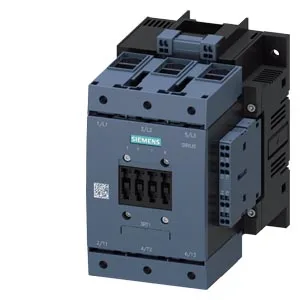
Its 200-220 VAC coil (50/60 Hz) pulls in and drops out within 40-60 ms, with an arcing time of 10-15 ms — fast enough for most motor start/stop sequences but not for high-speed inching.
The coil draws a holding power factor of 0.8 at both 50 Hz and 60 Hz, with an inrush factor of 1.1 times the sealed value — so the control transformer must be sized for the pick-up surge, not just the sealed VA. Switching frequency varies by duty: up to 1 000 cycles per hour in AC-3 and AC-3e (standard motor starting), 800 in AC-1 (resistive), 400 in AC-2 (slip-ring motor), and only 130 in AC-4 (plugging/reversing). If your application requires frequent reversing, the AC-4 limit is the binding constraint — not the AC-3 headline number. The built-in auxiliary switch is rated for 10 A at 24 V, 2 A at 48/60 V, 1 A at 110 V, 0.9 A at 125 V, and 0.3 A at 220 V — all DC resistive loads. These are the contact ratings for the aux block; do not exceed them when driving PLC inputs or indicator lamps. Electrical life will be lower and depends on the switched current and duty class.
Wiring and panel integration
The magnet coil connection uses spring-type terminals (push-in or cage clamp) accepting 2x (0.25... 2.5 mm²) solid or stranded wire. The main power terminals accept stranded conductors from 16 mm² up to 70 mm² — sized for the S6 frame's typical motor circuit. Dimensions are 172 mm high, 120 mm wide, and 170 mm deep.
Because it is active and widely specified, the typical sourcing posture is quoted-to-order against an RFQ.