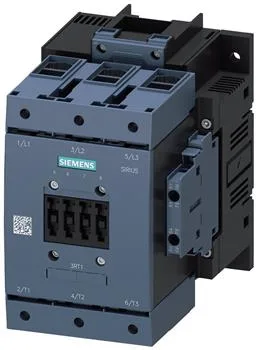
The 3RT1054-3AT36: The S6 frame size places this contactor in the mid-range of the SIRIUS family — sized for motor loads up to roughly 55-75 kW depending on duty class, though the exact motor rating depends on the application category and ambient conditions. The 575-600 V coil is a niche voltage tier, common in Canadian 600 V industrial systems and some 575 V mining installations; verify your control transformer taps match. Spring-type terminals on the coil mean no screw torque to check — push-in or cage-clamp style, faster for panel wiring but requires a ferrule on stranded wire for reliable connection. The main power terminals accept 16 to 70 mm² stranded, so this contactor handles supply cables up to 1/0 AWG roughly. Auxiliary terminals accept 2x 0.25 to 2.5 mm² solid or stranded. Switching frequency varies by duty: 1000 cycles/hour in AC-3 (standard motor start/stop), 800 in AC-1 (resistive), 400 in AC-2 (slip-ring motor), 130 in AC-4 (plugging/inching). The AC-3e rating also lists 1000 cycles/hour — same as standard AC-3, meaning no derating for the enhanced electrical endurance variant. Electrical life will be lower and depends on the switched current and voltage; for AC-3 duty at rated current expect roughly 1-2 million operations before contact replacement.
Power contactors of this class switch motors, transformers, resistive heaters, and capacitor banks in industrial control panels. The S6 frame with 575-600 V coil is specifically aimed at heavy industrial environments — mining conveyors, pump stations, compressor skids, and steel mill auxiliaries — where 600 V distribution is standard and panel space is at a premium.
Dimensions: 172 mm high, 120 mm wide, 170 mm deep. Mounting is screw fixing — no DIN rail adapter included, so plan for a backplate or mounting rail with drilled holes. Clearance distances: 10 mm upwards and downwards, 10 mm sideways, 20 mm forwards from the arcing zone. If your application needs faster make/break (e.g., for synchronizing or fast load shedding), consider a smaller frame or a dedicated fast-acting contactor. The auxiliary switch is included (1 NO + 1 NC typically on this frame), rated at 10 A at 24 V, 2 A at 48/60 V, 1 A at 110 V, 0.9 A at 125 V, 0.3 A at 220 V. These ratings are for the DC switching capability — inductive loads will require derating or a snubber.