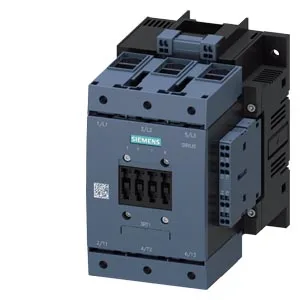
The coil is rated for 240-277 V AC, with a pickup threshold of 0.8 x rated value and a dropout threshold of 1.1 x rated value — so it holds in reliably down to about 192 V and drops out cleanly above 305 V. Coil terminals are spring-type, which speeds panel wiring and resists loosening under vibration.
At AC-3 duty (motor switching) the contactor is rated for 1000 operating cycles per hour; at AC-1 (resistive) it handles 800 ops/h, and at AC-4 (plugging/reversing) it drops to 130 ops/h. Auxiliary contacts are built in — rated 10 A at 24 V, 2 A at 48/60 V, 1 A at 110 V, 0.9 A at 125 V, and 0.3 A at 220 V — covering most PLC-level signal circuits without an add-on block. Wire range on the power circuit accepts 16-70 mm² stranded; the auxiliary circuit takes 2x 0.25-2.5 mm² solid or stranded. That covers everything from a 25 mm² motor feed down to a 1.5 mm² control wire — no adapter terminals needed for mixed gauges.
Mounts via screw fixing (four-point) on a vertical surface. Clearance requirements: 10 mm above and below, 20 mm forward, 10 mm to the side — plan for those gaps when laying out the gland plate and busbars.