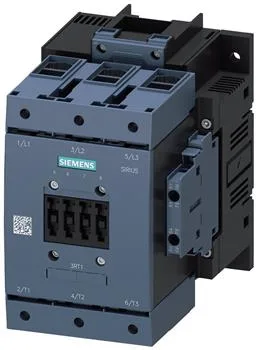
What this contactor does in the panel
Its coil pulls in at 200-277 V AC, and the magnet coil uses spring-type terminals — no screwdriver needed for the coil wiring, which speeds up panel assembly.
What the operating rates mean for your motor duty
The 3RT1054-3NP36 is rated for 1,000 operating cycles per hour in AC-3 duty (squirrel-cage motor starting), which is the typical benchmark for conveyor and pump contactors. AC-4 (plugging/inching) drops to 130 ops/h — the arc energy during reversal heats the contacts faster, so that lower limit governs if your application does inching or reversing. AC-1 resistive loads can run at 800 ops/h. The arcing time is 10-15 ms, consistent with a spring-return contactor.
Mounting and clearances — what fits in the enclosure
This contactor mounts via screw fixing, not DIN rail. The body is 172 mm high, 120 mm wide, 170 mm deep.
Wire termination — what fits the power and coil terminals
Power circuit terminals accept stranded wire from 16 to 70 mm² — that's the range for the main motor leads. The magnet coil terminals are spring-type, so strip and push; the power terminals are screw-type for the heavier cable.
Environmental limits — storage vs. running
Operating ambient temperature is -25 to +60 °C. Storage range is wider at -55 to +80 °C — that storage limit governs shipping and warehouse, not running. The contactor is not IP-rated for washdown; it's an open-panel device for indoor control cabinets.