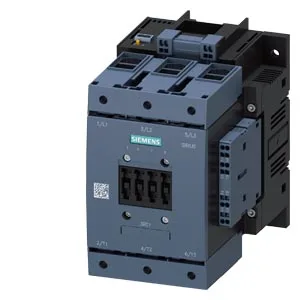
It is rated for switching frequencies that vary by duty class: up to 1 000 1/h in AC-3 (standard motor starting), 800 1/h in AC-1 (resistive), and 400 1/h in AC-2 (slip-ring motors). For DC loads, it handles up to 500 1/h in DC-3 and DC-5, and 400 1/h in DC-1. This means the contactor is sized for continuous cycling in motor control panels, not just occasional on/off.
Coil and switching characteristics
The DC coil operates at 24 V rated value, with a pickup hold-in factor of 0.7 and a full-scale value of 1.25. For DC load breaking, the contactor is rated at 6 A at 24 V, 2 A at 48 V, and 2 A at 60 V — so it can interrupt DC auxiliary circuits at those levels, not just AC motor loads.
Mounting is by screw fixing through a single 9 mm hole. The main circuit wiring accepts up to 2x 70 mm² stranded cable; the auxiliary/control circuit takes 2x (0.25 to 2.5 mm²) solid or stranded. This is a panel-mount part, not DIN-rail — plan for screw-down installation and adequate bending radius for 70 mm² cable.