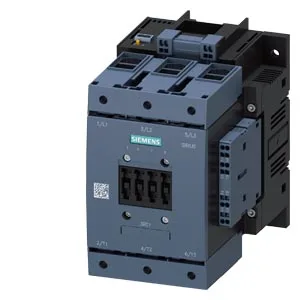
Panel Fit and Mounting Reality
The 3RT1054-3XJ46-0LA2: This SIRIUS contactor measures 172 mm high by 120 mm wide by 170 mm deep — the depth is the dimension that catches you on a shallow backpanel. Mounting is via screw fixing through 9 mm diameter holes, not DIN rail, so plan the drilling pattern ahead of the build. The mounting position allows a vertical surface with +/-90° rotation and +/-22.5° tilt forward/back — useful when the gland plate forces an angled install, but the screw-fix means no quick-release for swap-out. Clearance requirements: 10 mm upwards, 20 mm forwards, 10 mm downwards, 10 mm at the side. That 20 mm forward gap is the one to watch — it's the arc-chamber breathing space.
Wiring Capacity and Termination
Main contact termination accepts stranded cable up to 2x 70 mm² — that's a serious conductor for a size S6 frame, suitable for high-current motor feeds. Solid wire is limited to 2x (0.25...2.5 mm²), so if your panel uses solid tails for control wiring, keep the main power on stranded. Auxiliary switch is present, but the solid/stranded spec for aux circuits is the same 2x (0.25...2.5 mm²) range — fine for signal wiring, but don't try to share the aux terminals with the main power.
DC Coil and Switching Performance
The coil is DC-rated at 72 V with a switching time of 80...90 ms and an arcing time of 10...15 ms. That 80-90 ms pull-in is slower than an AC coil — expect a noticeable delay if you're sequencing contactors in a safety circuit. The initial value of 0.7 suggests a pick-up voltage threshold around 50 V; if your DC bus droops under load, the contactor may drop out before the motor stops. DC rated currents: 6 A at 24 V, 2 A at 48 V, 2 A at 60 V. The steep derating from 24 V to 48 V tells you the contact gap is optimised for lower DC voltages — don't assume the 72 V coil rating means the contacts can break 6 A at 72 V.
Switching Frequency by Duty Class
Maximum switching frequencies vary significantly by duty: AC-3 (motor starting) allows 1 000 cycles/hour, AC-4 (inching/plugging) drops to 130 cycles/hour, and DC-1 (resistive) allows 400 cycles/hour. If your application involves frequent reversing or jogging, the AC-4 limit of 130 ops/hour is the binding constraint — the contactor will overheat if you exceed it. The AC-3e rating also shows 1 000 ops/hour — this is the enhanced AC-3 duty for modern motor starters with electronic overloads. It matches the standard AC-3 figure, so no penalty for using an electronic OL relay.
Lifecycle and Sourcing Reality
Operating temperature range is -40 to +70 °C, storage -55 to +80 °C — wide enough for unheated warehouses and outdoor cabinet installs. The mechanical life of the contactor is typical 10 million operations, so this is a fit-and-forget component for most duty cycles.