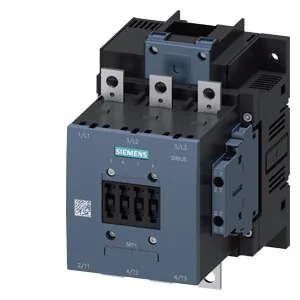
The 380-420 V AC coil makes it a straight fit for 400 V line-fed panels common across Europe and much of Asia. Main-circuit wiring accepts stranded conductors from 25 up to 120 mm², so it handles the full current range the S6 frame is rated for without needing terminal adapters.
At 172 x 120 x 170 mm (height, width, depth), this contactor occupies a standard S6 footprint on a mounting plate. Fastening is screw fixing, not DIN rail — plan for drilled holes on a backplate or sub-panel. That means in a multi-contactor row you can butt them side-to-side at 10 mm spacing, but the forward arc zone needs 20 mm clear of any metal or enclosure door. Arcing time is 10-15 ms — short enough that arc flash containment is manageable with standard IP2X barriers.
Switching frequency by duty class
The contactor's maximum switching frequency depends on the load type. In AC-3 (standard squirrel-cage motor starting) it manages 1,000 operations per hour, same for AC-3e. AC-1 (resistive loads) drops to 800 ops/h, AC-2 (slip-ring motors) to 400 ops/h, and AC-4 (plugging/inching) to 130 ops/h. For a conveyor drive cycling every 3.6 seconds, the AC-3 rate works; for a press brake with frequent reversing, the AC-4 limit governs — that's the number that decides whether the contactor lasts the shift.
Coil and auxiliary circuit details
The magnet coil uses screw-type terminals, not quick-connects — expect to torque ring or fork terminals. Operate time is 40-60 ms on both AC and DC supplies, so timing in a sequence is predictable regardless of control voltage type. The auxiliary switch block handles 10 A at 24 V, 2 A at 48 V and 60 V, and 1 A at 110 V — enough for PLC input sensing or pilot lights, but check your specific load against the curve if driving small DC relays. Auxiliary terminal wiring accepts 2x 0.5-1.5 mm² solid, 2x 0.75-2.5 mm² solid, or max 2x 0.75-4 mm² stranded. Use ferrules on stranded wire.