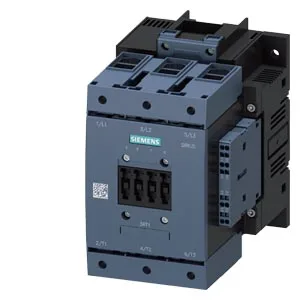
The coil is wound for 440-480 VAC at 50/60 Hz, terminated at screw-type terminals — no push-on or spring-cage option on this variant. Rated operating range covered in the spec table. The coil pulls in and drops out within 40 to 60 ms on both AC and DC supplies — consistent timing whether you're driving it from a control transformer or a DC-supplied safety circuit.
Switching frequency is duty-class dependent: 1000 operations per hour at AC-3 (motor starting), 800 ops/h at AC-1 (resistive), 400 ops/h at AC-2 (slip-ring motor), and only 130 ops/h at AC-4 (plugging/inching). The AC-3e rating also caps at 1000 ops/h. If your application cycles faster than that, the contactor's electrical life drops off the datasheet curve — oversize to the next frame or add a bypass contactor. Auxiliary contacts are present and rated for switching: 10 A at 24 V, 2 A at 48 V and 60 V, 1 A at 110 V, 0.9 A at 125 V, 0.3 A at 220 V. These are the break capacities for the built-in auxiliary switch block — enough for PLC inputs or relay coils, but not for direct motor pilot duty above those currents.
Fastened by screw fixing through a single 9 mm hole. Envelope dimensions: 170 mm deep, 120 mm wide, 172 mm high. That 20 mm forward gap is the one most panel layouts miss — skimp on it and you lose access to the coil terminals. Terminal capacity accepts 2 x (0.5 to 1.5 mm²), 2 x (0.75 to 2.5 mm²), or max 2 x (0.75 to 4 mm²) solid or stranded. Strip length and ferrule sizing per the installation instructions — the 4 mm² max per conductor is the binding constraint if you're paralleling feeds.
Environmental range and lifecycle
The storage range exceeds operating — that limit governs handling and shipping, not running. Mechanical life of the contactor is typically 10 million operations. Lifecycle status is current production — this is not a phase-out or NRND line.